Badly Breaking

David Lynch is known for not explaining things. In one interview he famously said that Eraserhead is his “most spiritual film,” and when the interviewer asked him to elaborate, he simply said, “No.”
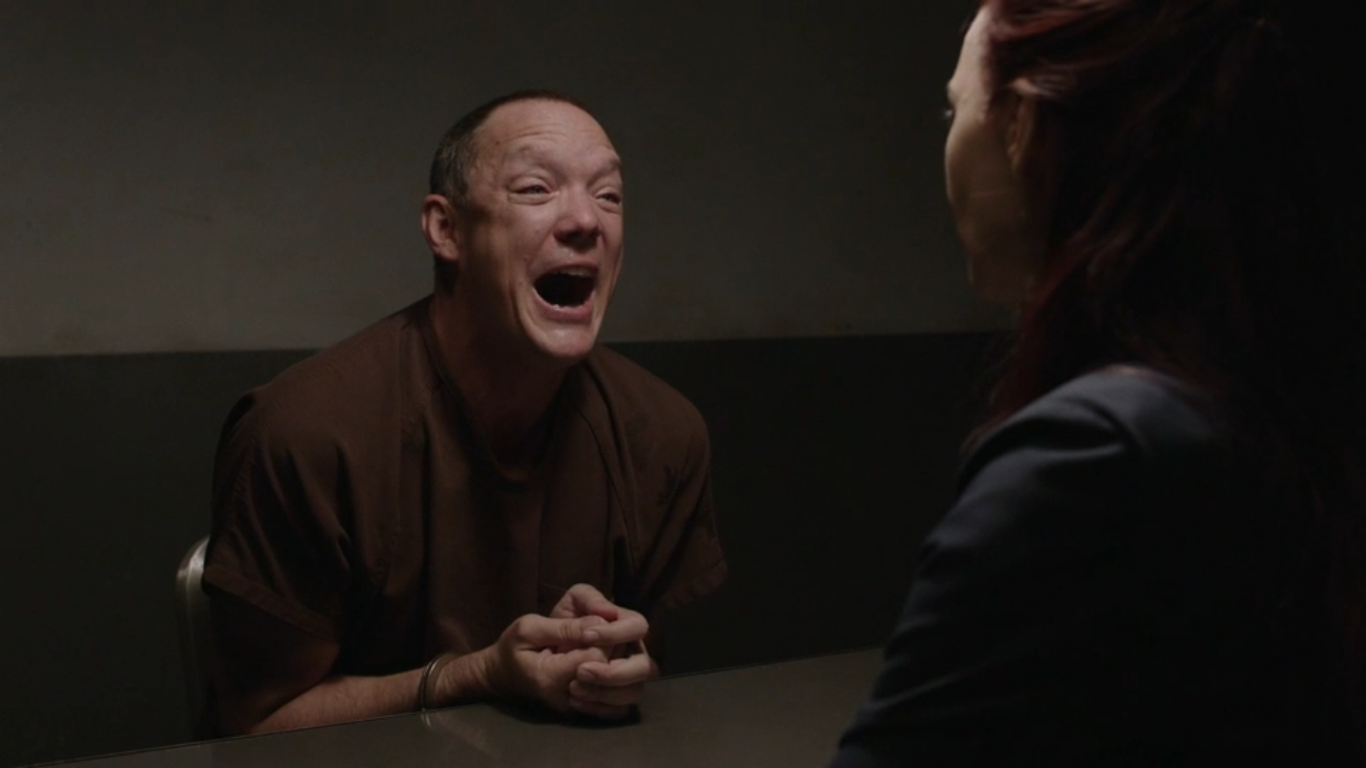
I became a huge fan of Twin Peaks over the past few years, and Maggie Mae Fish’s videos about it really helped me get a handle on what’s even going on there. I don’t think there can or should be a definitive explanation for Twin Peaks, but a lot of things about it make more sense from the point of view of that under the surface each part of it is savagely critiquing the medium it’s situated in. The original run had a lot to do with how network television treated victims of crimes as disposable, forgotten by the time the next week’s episode came out. The movie Twin Peaks: Fire Walk With Me has a lot to do with the issues with film (plus a jab at cable TV with "Sheriff Cable"), especially Silence of the Lambs. The third season, made as a prestige TV series for Showtime, goes after prestige TV. Probably the most over the top instance of this is how Dale Cooper spends most of the show reduced to a suburban simpleton yet circumstances, Black Lodge magic, and people’s assumptions about him constantly conspire to make him succeed. The (white, male) protagonists of prestige TV can be childish and do stupid things, yet they succeed at least long enough to make the show interesting. Another example is the character of Bill Hastings, a middle-aged high school principal who is falsely accused of murder, reducing him to a blubbering wreck. This may be what David Lynch thinks of Walter White from Breaking Bad.
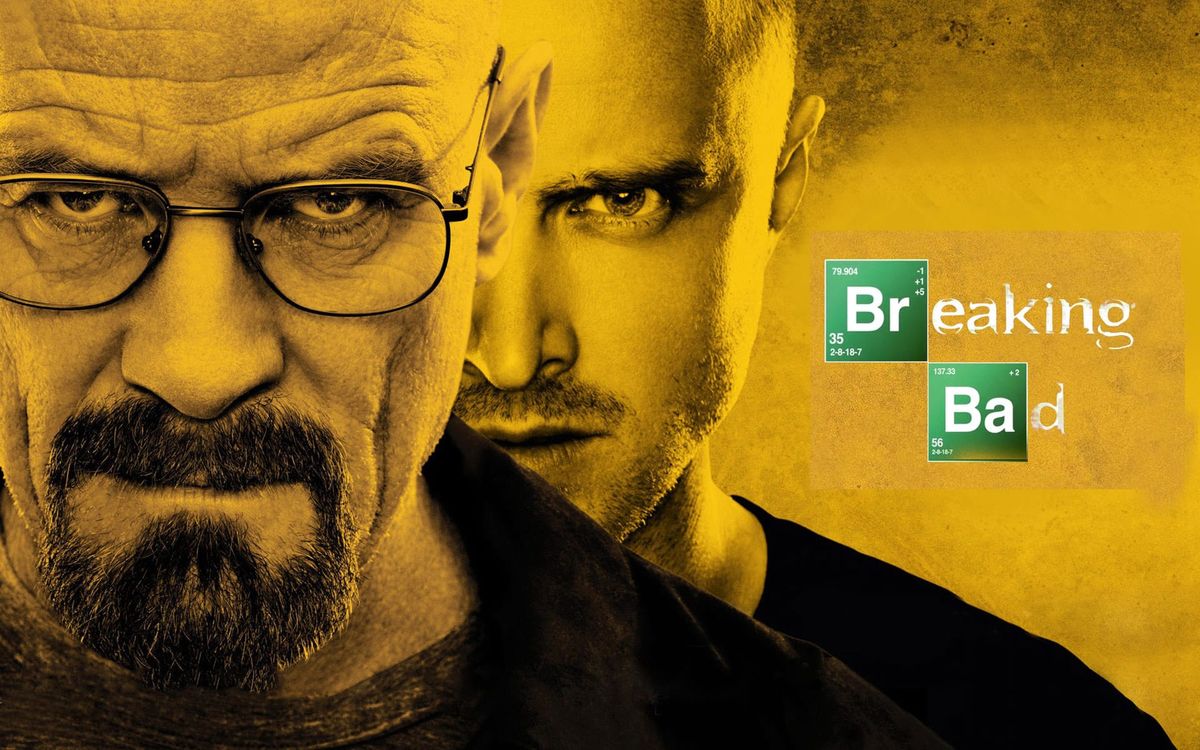
On an episode of the What a Time to Be Alive podcast, host Kath Barbadoro mentioned that in Breaking Bad, Walter White was always a pathetic character. It had been years since I'd last watched the show, and that inspired me to watch it again. I originally saw it as a story about a good man who goes bad, but when I came at it looking for the ways in which Walter sucks, it was a very different and altogether better experience. I was a lot more aware of what was happening, and I think more plugged into the intended message. The series has a lot of symbolism and a lot to say about masculinity, and although a lot of people clearly didn’t pick up on it, that may explain why it was such a hit, much more so than its spinoffs. The most successful, iconic media tends to be things that capture something in the zeitgeist.
The premise of Breaking Bad is well-known, but to be clear, it’s about a high school chemistry teacher who has a likely fatal case of lung cancer and starts using his knowledge of chemistry to cook crystal meth to make money to support his family, which includes a teenage son with cerebral palsy and a pregnant wife. He enlists a former student of his, Jesse Pinkman, to help him with the endeavor, and their fraught relationship is a major through-line of the series.
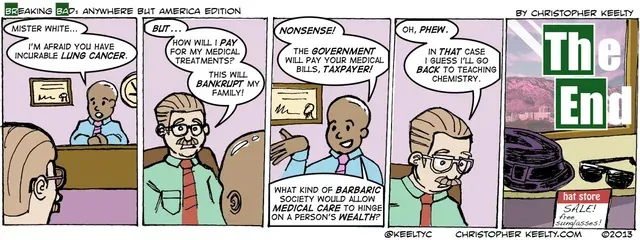
There’s a joke that a Canadian Breaking Bad would be a lot shorter because he wouldn’t have to worry about paying for his cancer treatment, but that misses the larger issues with Walt’s character. He has some good points, but he’s an incredibly prideful, arrogant man, burdened with a need to assert his masculinity. He was part of a startup company but left before it went big. His resentment explodes when he sees his former business partners again, and he point blank refuses to take their offer of a job that would give him plenty of money. Likewise, when his son sets up a website to solicit donations (a few years before GoFundMe would become a thing), he initially dismisses it as “begging.” In contrast, while Jesse is a hard living young man who uses the word “bitch” constantly, underneath he’s basically a good guy, and in portraying him actor Aaron Paul seems to have gotten really good at doing anguished crying.
Walt’s actions quickly become despicable. Meth is already a terrible drug that destroys lives, but to keep the scheme going he ends up killing people. At first the victims are dangerous criminals, but when Jesse is ready to run off with his girlfriend Jane (played by Krysten Ritter), Walt lets her choke on her own vomit and die, leaving Jesse wracked with guilt. Her death in turn devastates Jane’s father (played by John de Lancie), and when he tries to go back to work as an air traffic controller, his negligence causes two planes to collide in mid-air, adding 167 innocents to the pile and leaving Albuquerque and the nation shell-shocked.
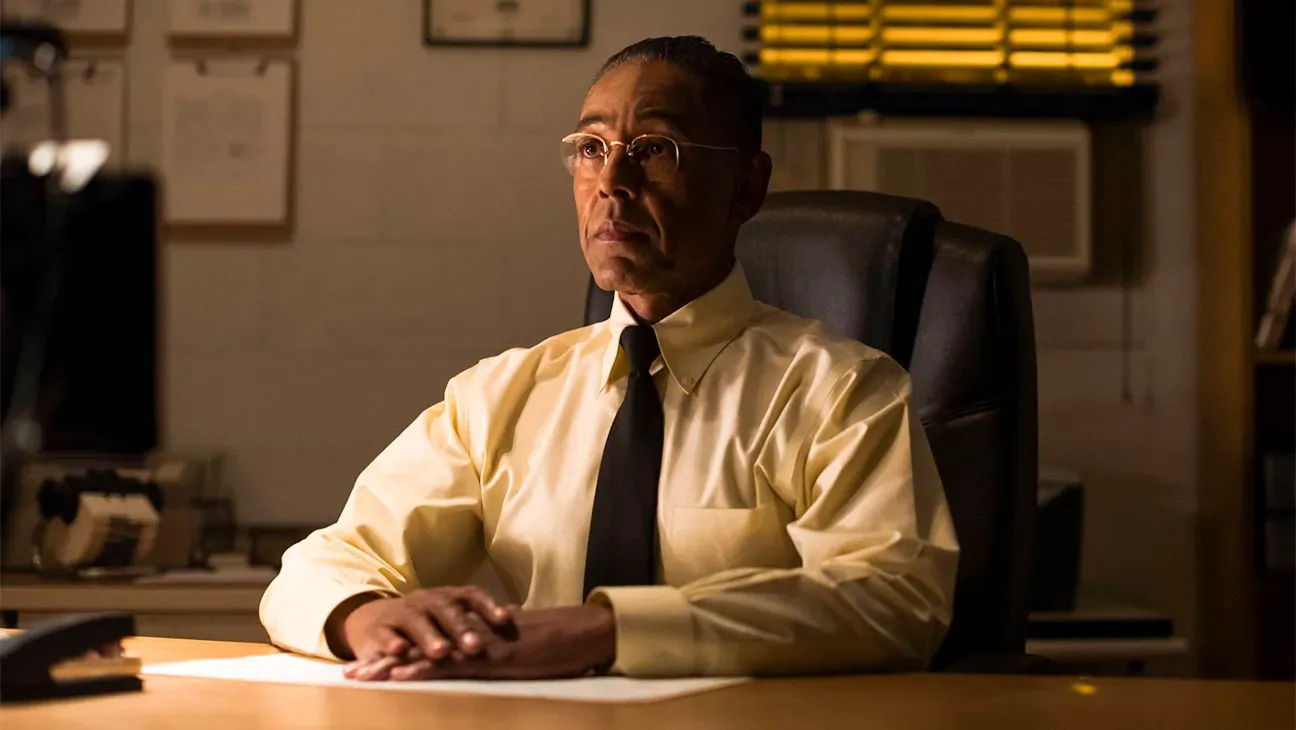
One of the more interesting characters in the middle of this whole mess is Gus Fring, a Chilean-American immigrant, entrepreneur, and drug lord, played by Giancarlo Esposito. It became so iconic that Esposito winds up playing variations of Gus Fring in practically every role he gets. Gus is an incredibly precise, focused, and ruthless man, and he comes to the meth game with a level of professionalism that Walt seems to aspire to but mostly lacks. Where Walt makes mistakes that risk everything, Gus has a sophisticated and well-oiled operation hidden under his more legitimate business ventures. It’s hard to say where the façade of an upstanding member of the community ends and the real Gus begins, whether he’s sincere when he contributes to Walt’s cancer treatment or the DEA’s fun run, but that’s part of why it’s such a good cover. His skill at running his operation and the power he consequently wields force Walt to do business with him, though of course Gus wants his new business partner to show the right kind of caution and not bring everything crashing down. In season 2, Gus asks Walt why he’s so insistent about keeping Jesse around, and Walt says, “He does what I say.” When Gus provides him with a promising chemist as a new assistant, Walt grabs the first excuse he can to get Jesse back.
When Walt is ready to retire from the meth game, Gus ultimately gets him back to cooking by telling him that a man provides for his family, even if he isn’t loved. Walt’s masculine pride is his Achilles heel, and Gus is ruthless enough to exploit it. Walt certainly does lose the love of his family, and as the series draws to a close his wife and son want nothing to do with him or his money.
Walt isn’t the only character who struggles with toxic masculinity. His brother-in-law Hank is a DEA agent with a penchant for crude jokes, and who wrecks his career in an obsessive pursuit of a meth kingpin he doesn’t know is actually Walt. When he gets into a shootout with the dangerous and unstable drug lord Tuco Salamanca, he escapes unharmed physically but bears trauma from the experience that fuels his obsession, to the point where in a fit of rage he pummels Jesse badly enough to send him to the hospital. When Tuco’s cousins come to take revenge, Hank is left bleeding out in a parking lot, and just barely survives as man broken physically as well as mentally. He starts collecting rocks, as though it’s a way to recapture the hardness that his injuries took from him. His physical therapy eventually gets him able to walk again, but it’s a long battle that he seems reticent to fight.
Baldness, which is more common in men with higher testosterone, seems to be a visual symbol of excess masculinity here. Walt takes a turn when he starts shaving his head, and he finds that on an emotional level he and the already bald Hank are very similar. The cousins are taciturn, ruthless killers, and their heads are always perfectly shaved, a cartoonish extreme of the thing that burdens Walt and Hank. Later in the series Jesse’s spiky hair gives way to a buzz cut, while the fixer Mike and the retired drug lord Hector are naturally bald with age.
The events of the series come to a head in season 4, when Walt gets on Gus’ bad side. After a few different attempts at killing Gus, Walt finally succeeds by getting Hector Salamanca to agree to having a bomb wired to his wheelchair so he can lure Gus to him, at last giving him revenge for the deaths of Tuco and the cousins. After the blast, Gus calmly steps out of the room and straightens his tie. The camera angle suddenly reveals to the viewer that the bomb blew off half his face, and after that macabre moment, he collapses. Even as he dies a gruesome death, Gus manages to be more dignified than Walt.
Series creator Vince Gilligan said that one of the major themes of the series is “actions have consequences.” He very deliberately set out to create a world where bad deeds are punished. Season 5 is ultimately about the fallout from Gus’ death and the consequences of Walt’s actions finally, truly coming back to bite him. Some of that is unavoidable for Walt because of things like Mike’s associates landing in jail and the need to come up with money to pay them to stay quiet, but others are entirely avoidable. There comes a point where they’re sitting on a thousand gallons of methylamine and an Arizona drug lord is willing to pay millions for it, but Walter refuses. It’s an easy out that would leave him with more than enough money to do whatever he wants, but he admits to Jesse that after years of checking that startup’s value every single week, the meth business is the only real success he has to his name. Where Walter only gets more determined to keep things going, Jesse takes on progressively more trauma as the deaths and other harm weigh on him more and more.
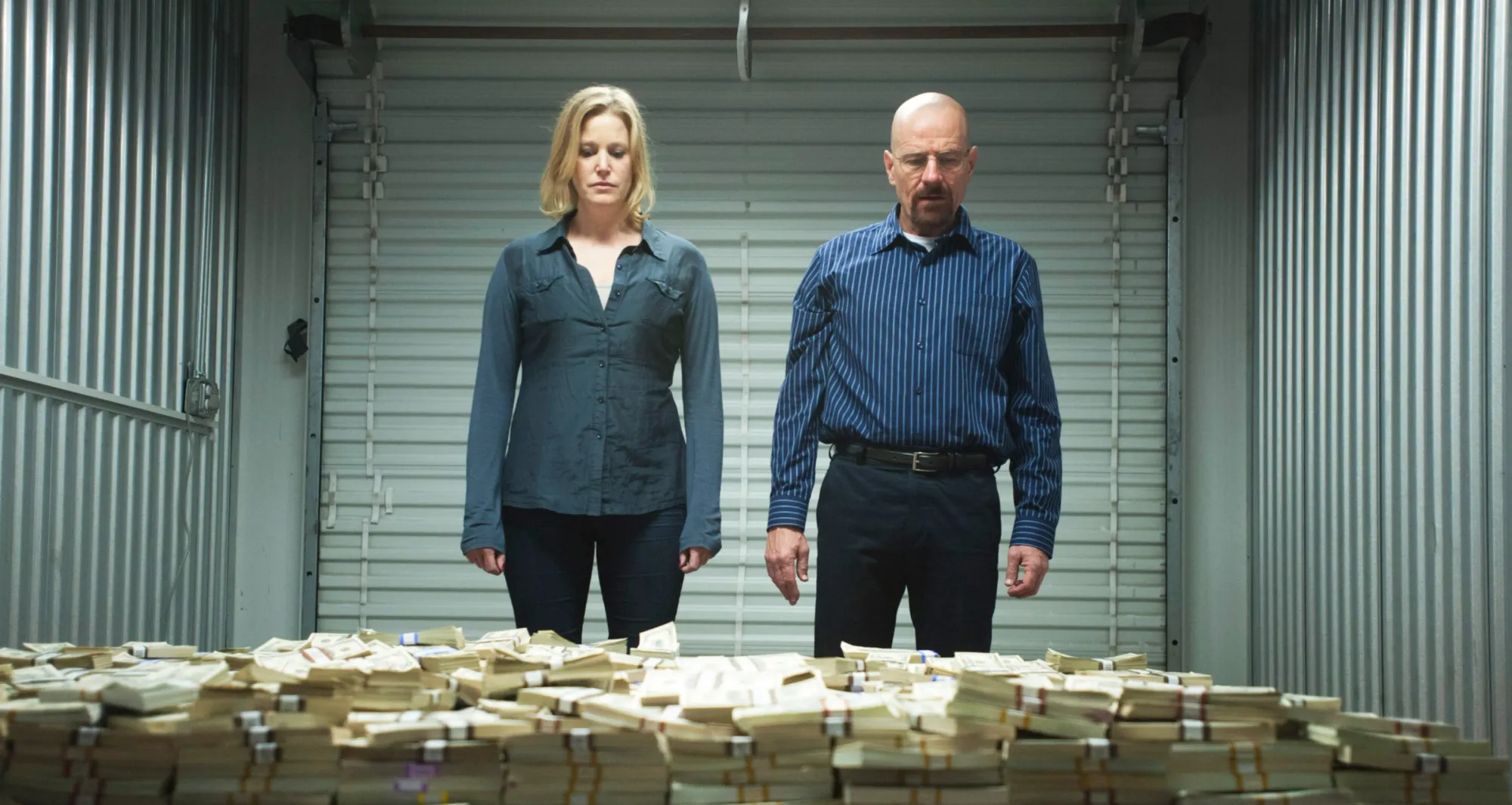
The series ends with Walt returning to Albuquerque to tie up loose ends. The most crucial part of this is when he pays Skyler a visit and admits to her that he didn’t do it all for his family, but for himself. He was good at it (the cooking part at least), and it made him feel alive. In an age of atomized urban ennui, a lot of us can relate to that need to do something significant, which is another thing that helps explain the series’ huge success.
El Camino is a more recent movie that serves as an epilogue, for anyone who wanted to know what happened to Jesse after the series finale. Here we see a young man truly haunted by what he’s been through. The white supremacist Arizona drug lord kept him in a pit, only letting him out to cook meth, and they made him watch as they killed the woman he loves. His friends Badger and Skinny Pete are quick to give him what help they can—despite the drug dealing they’re legitimately good friends—but he has to fight his way to the money to pay a fixer to relocate him. His story ends with his arrival in Alaska, what Mike told him was the last frontier, ready to start a new life under a new name.
While watching I got inspired to buy a Los Pollos Hermanos T-shirt. I wore it to work, and it turns out that wearing a Breaking Bad T-shirt is a good way to find out just how many people around you are fans of the series. While I'm sure Vince Gilligan appreciates the royalty checks, the chicken restaurant isn't exactly central to the show's themes. One of the threads of the third season of Twin Peaks is a commentary on how the fandom can be shallow. David Lynch is trying to say something about the human condition, and people are repeating stuff about damn fine coffee and cherry pie. The imbecilic version of Cooper similarly latches onto such things, jumping at the chance to enjoy good coffee and pie.
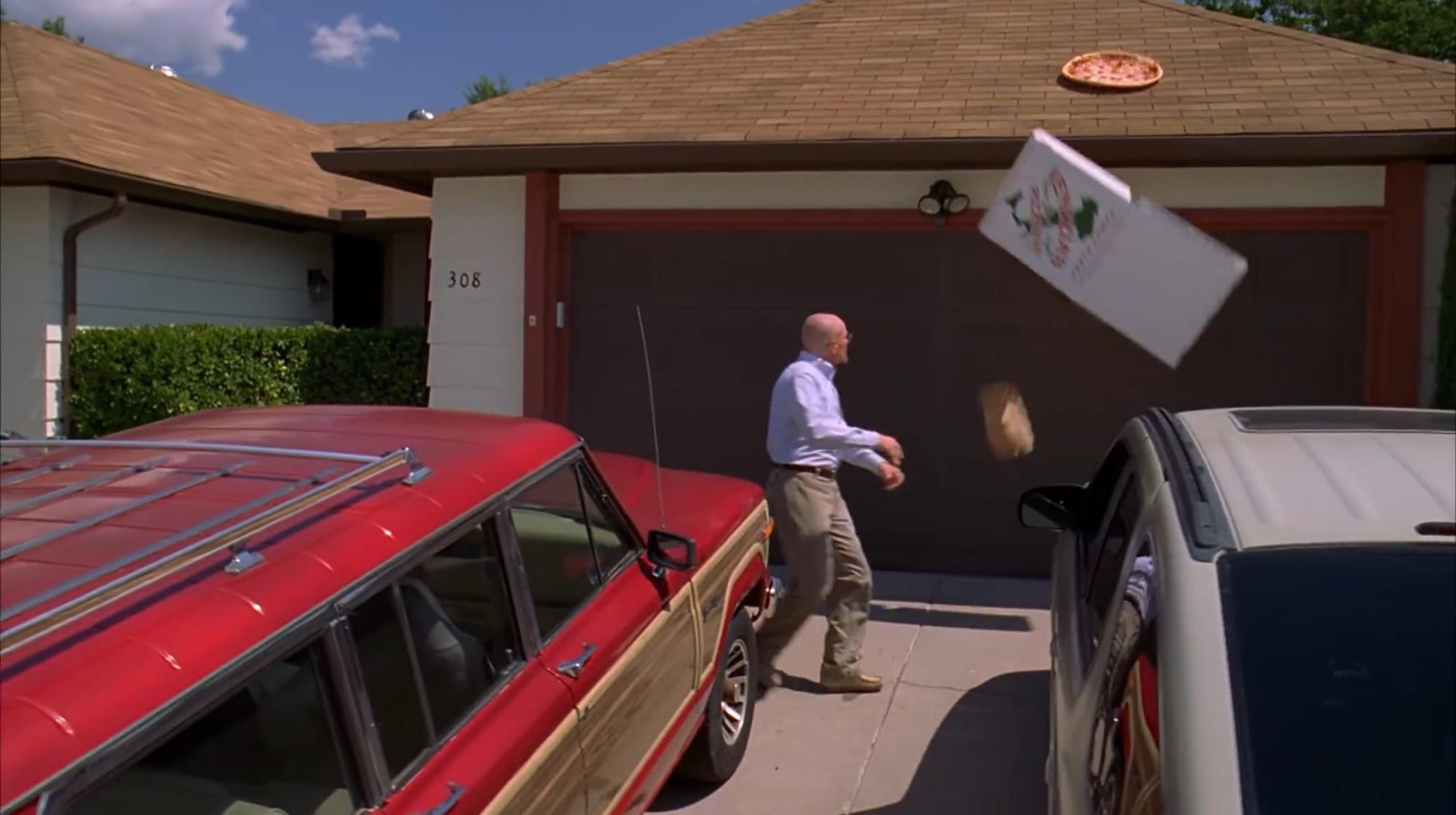
The Breaking Bad fandom similarly turns elements from their show into shallow memes, sometimes in unfortunate ways. At one point Walt gets angry and hurls a pizza up on the roof of the family home, and despite this being yet another pathetic moment for the character, quite a few people have gone to the house used for filming and tried their hands at pizza throwing. The house has ordinary people living inside it, and they’re understandably not happy with the attention and flying pizzas, which may explain why Google Street View now shows it with a fence that wasn’t there in the series. The Candy Lady candy shop in Old Town, already a bit of an Albuquerque institution, provided rock candy to stand in as meth in the show, and they’re quite happy to sell it and other Breaking Bad merch to fans.
There are certain lines that really stuck with people, enough so to get removed of their original context. Bryan Cranston delivered the line “I am the danger” perfectly, but people forget that when Walt said that he was trying to brush off his wife correctly pointing out that he was in over his head dealing with someone as ruthless as Gus. When he says, “Say my name,” he’s fishing for the Arizona drug lord to admit he knows the great Heisenberg, and getting in bed with that gang turns out to be a terrible and completely avoidable mistake.
Another thing with the fandom is the sheer amount of hate that Walt’s wife Skyler gets. She isn’t a perfect angel—at one point she starts sleeping with her boss, partly just to hurt Walt—but a lot of her actions ultimately come down to trying to protect her kids from the consequences of Walt’s actions. If anything, she’s a lot kinder to him than she needs to be, and she specifically doesn’t turn him in.
At the very end, Walt has Badger and Skinny Pete use laser pointers to convince his former business partners that he has hitmen ready to kill them if they don’t set up a trust for his children; he poisons Lydia, the cowardly woman who helped set up the new meth operation; he admits the truth to Skyler; and finally he uses a cleverly rigged machine gun on a garage door opener mechanism to kill the drug lord’s gang and free Jesse. Then having taken a shot from his own machine gun, he admires the meth cooking lab for a bit before dropping dead, just as the police arrive.
Vince Gilligan followed Breaking Bad with Better Call Saul, a prequel series about how a conman named Jimmy McGill becomes the Saul Goodman we know from the original series. It’s still very much an AMC prestige drama, but about a lawyer who tries to bamboozle his way through life. It’s just as well-crafted as Breaking Bad, and while it lasted for six seasons—slightly longer than BB—it wasn’t the same kind of breakout hit. Saul is a compelling character, basically a good guy trying to help people out, but willing to get into some shady stuff if it’ll help him get ahead. He’s a bit of a trickster underdog figure, and while we love a good trickster underdog, we apparently like masculine ambition even more.