Writing in Miniature

Join my Patreon to get early access to posts, plus bonus material and a backlog of essays, fiction, and games!
Word count is a useful metric for the length of a piece of writing. It’s not exact—words themselves vary in length of course—but it’s good enough to give the gist. On the other hand, it has no correlation with how much effort and thought go into the contents. A 50,000-word graduate thesis and a 50,000-word NaNoWriMo novel will have very different levels of consideration, research, and planning. I’ve done NaNoWriMo three times, and it’s produced three rough drafts that I haven’t managed to whip into shape years later. For both TTRPG design and fiction writing, there are things where I end up needing to figure out the right approach to an issue. That inspiration can come from things like research, advice from others, or random flashes of insight. With my Xeroverse novels I ran into one of those creative roadblocks, and I think it’s instructive how I got past it.
I’ve tried various ways to systematize prose writing, using things like Save the Cat, Rock Your Plot!, Rory’s Story Cubes, and my own creations like Entanglements and Depths. These all have their uses, but for me personally, none of them compare to doing a little free writing to help think things through. Cathy Yardley’s Rock Your Plot! divides authors into “plotters” and “pantsers.” Plotters plan out the story’s plot in detail and then start writing, while pantsers write “by the seat of their pants,” without a detailed outline. I’ve found that I’m firmly a punster, and while I benefit from doing some planning, overall my muse just refuses formalized systems.
Some writers and writing teachers fetishize Joseph Campbell’s “Hero’s Journey,” but it’s neither an accurate summation of world mythology nor especially good as a writing tool. More importantly, it’s only one of many ways to structure a story, both formal and informal. Japan and some other Asian cultures have a four-act structure called Kishōtenketsu (起承転結), and 4-panel manga is essentially a type of comic strip that gives each stage of the Kishōtenketsu structure a single panel. The monomyth follows a Western three-act structure, but up until the 18th Century, plays in the western world (including those of Shakespeare) used a five-act structure. There are a lot of story structures out there, ranging from ancient oral traditions to modern innovations, so even within the realm of writing tools, sticking with the monomyth’s three-act structure is limiting.
Some writers find these kinds of structures helpful, but as with 4-panel manga, the more experienced you get as a creator, the more rigid structures will start to chafe. For a while it was a cliché that webcomic artists would start off doing a 4-panel format before finally switching to more freeform comic pages because it turned out to be so much more expressive. 4-panel maga can be amazing, but the format is inherently at its best for gag comics without much story. The format had its zenith because of Azumanga Daioh and the bevy of slice of life schoolgirl comedy manga that came in its wake. (I did a TTRPG called Raspberry Heaven, so I read a lot of them as research.)
I’ve been writing my Xeroverse novels through my usual methods, which is to say by just writing stuff and periodically taking breaks to think things through, usually by free writing in a notebook (or on my typewriter) until I arrive at a solution to whatever I’m working on. Occasionally I’ll switch to things like asking friends for advice, searching Wikipedia, using random generators, or immersing myself in related media. Both the first and second Xeroverse books (Xero to Hero and M-Force: Messiah) conclude with big, messy fight scenes with several different characters in action. The first one has seven different characters, plus a car, a MacGuffin making a sky beam, and a big swarm of drones. The second has more than a dozen named characters of various factions, plus a bunch of robots and power armored troops, and the military starts a bombardment. In both cases, just keeping track of everything got to be a headache. It needs to have a certain internal logic even if it looks totally chaotic to the audience, so I needed a way to keep track of things.
Ages ago I accumulated a modest collection of generic board game components, things like colored pawns, tokens, spinners, meeples, etc., in addition to the many dice that I already own as a TTRPG guy. At the time I’d been interested in experimenting with using these components in TTRPGs, but that never really happened, so they’ve been sitting in a drawer for a long time. Designing for atypical components in a TTRPG is one of those things that can have a lot of work go into a small word count. I had the idea to play out the battle on a table, not using formal rules, but simply using physical pieces to better visualize the action.
When I had this idea while working on Xero to Hero, I decided that for that I really wanted a dry erase battle mat. I've used them for D&D and lot in the past, but if I still had one, I couldn't find it. With inspiration having struck, I didn’t feel like waiting for shipping, not even Amazon Prime shipping. I discovered that there was now a Micro Center in my area that carried Chessex battle mats, so I headed out almost immediately. It turned out that the Micro Center had opened the day before, and was still in the midst of a grand opening that saw the store completely packed, with ridiculously long lines just to check out. I lucked out in that there was a very nice game store in the same shopping center (Illusive Comics & Games) that carries exactly the battle mat I wanted. Once I got home, I was all ready to go… except the one dry erase marker I had was completely dried out (which feel like a joke), so I made a quick trip to Daiso to get some more.
To write the climax, I set up at a table in the back yard, with my laptop, the battle mat, a dry erase marker, the pawns, a bunch of ohajiki (Japanese flat marbles, which I still have a bunch of because of Golden Sky Stories), and a bottle of mugicha (Japanese barley tea) from Daiso. I drew the car, the “quantum engine,” and some concrete pillars, and used the pawns and ohajiki for the rest. (Since I already had black and red pawns in use, I stacked a hollow black one on top of a regular red one to be Killfile; he wears a black suit with red highlights.)
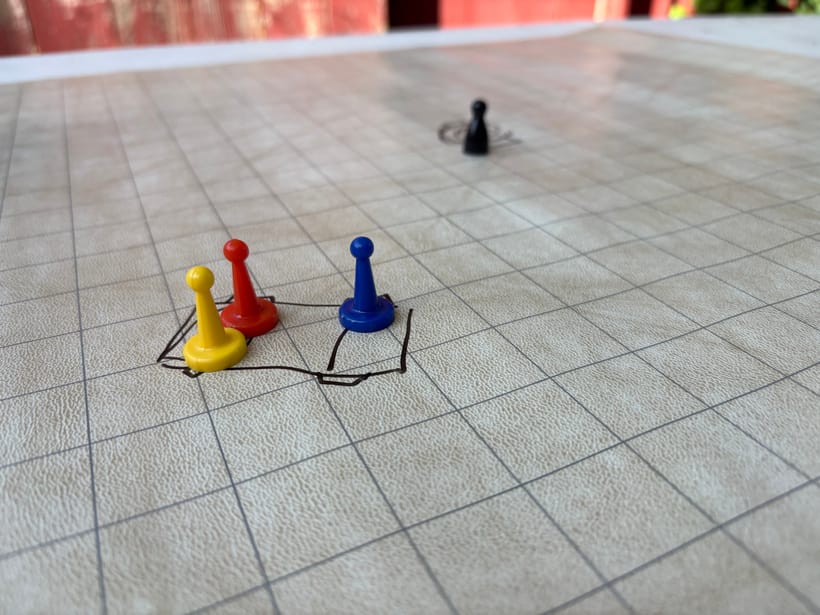
I didn’t follow any rules per se, but visualizing the battle that way was incredibly helpful. As I went over the scene, the components and battle mat kept suggesting little touches. I probably wouldn’t have realized that Sparky got that close to the K’zmic Gem without that for example, which gave me the idea to have a nice bit where she tries it out (it amplifies superpowers) and then gets disappointed that she can’t keep it. Similarly, I described the characters wiping out the drones, which was why I added the villain using a voice command to send in more of them when their numbers got too thin, until he finally ran out entirely. With that many characters, it’s easy to forget about some of them, so the visual reminder also just brought them to the fore. I may not have mentioned Buzz or Sparky for a few paragraphs, but the black and orange pawns I chose for them were right there reminding me.
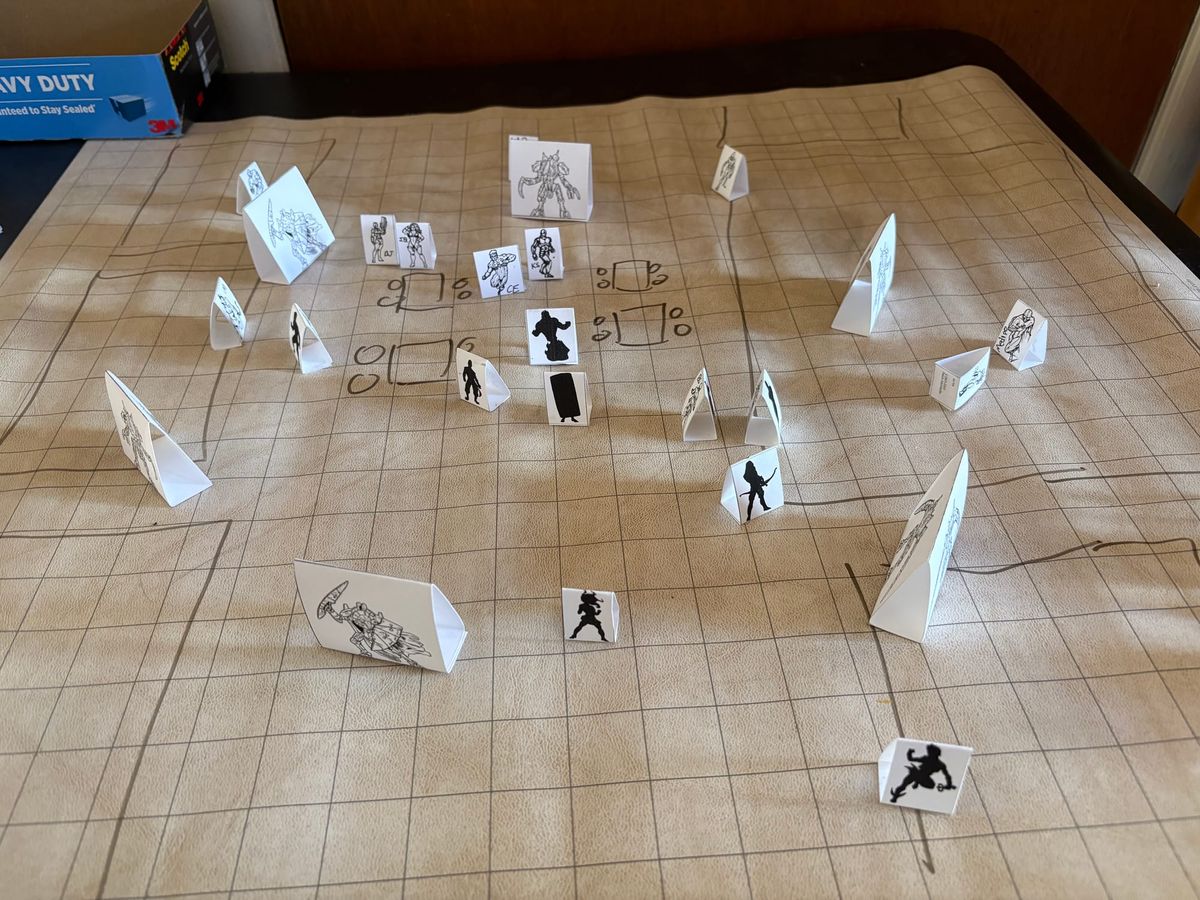
For M-Force: Messiah I resorted to cardstock miniatures. There are several publishers and individuals who make PDFs of printable paper miniatures available to buy/download, and Precis Intermedia Group’s “Disposable Heroes” line has a decent set of not-quite-trademark-infringing superheroes. I bought and downloaded it, and supplemented with some free paper minis of sci-fi robots and Warhammer 40k Space Marines and set about cutting them out and gluing them together with a glue stick. It wasn’t as impactful on the process of writing those scenes as in the first book, but it still helped me juggle all those characters. I turned several of the Disposable Heroes minis into specific characters by writing their initials on them, but I also used a few of the others to fill in some unamed characters, actually basing their descriptions on the art on the minis. The action wound up being driven more by personalities than tactics or environments, hence the map and minis approach didn't figure into things quite so much.
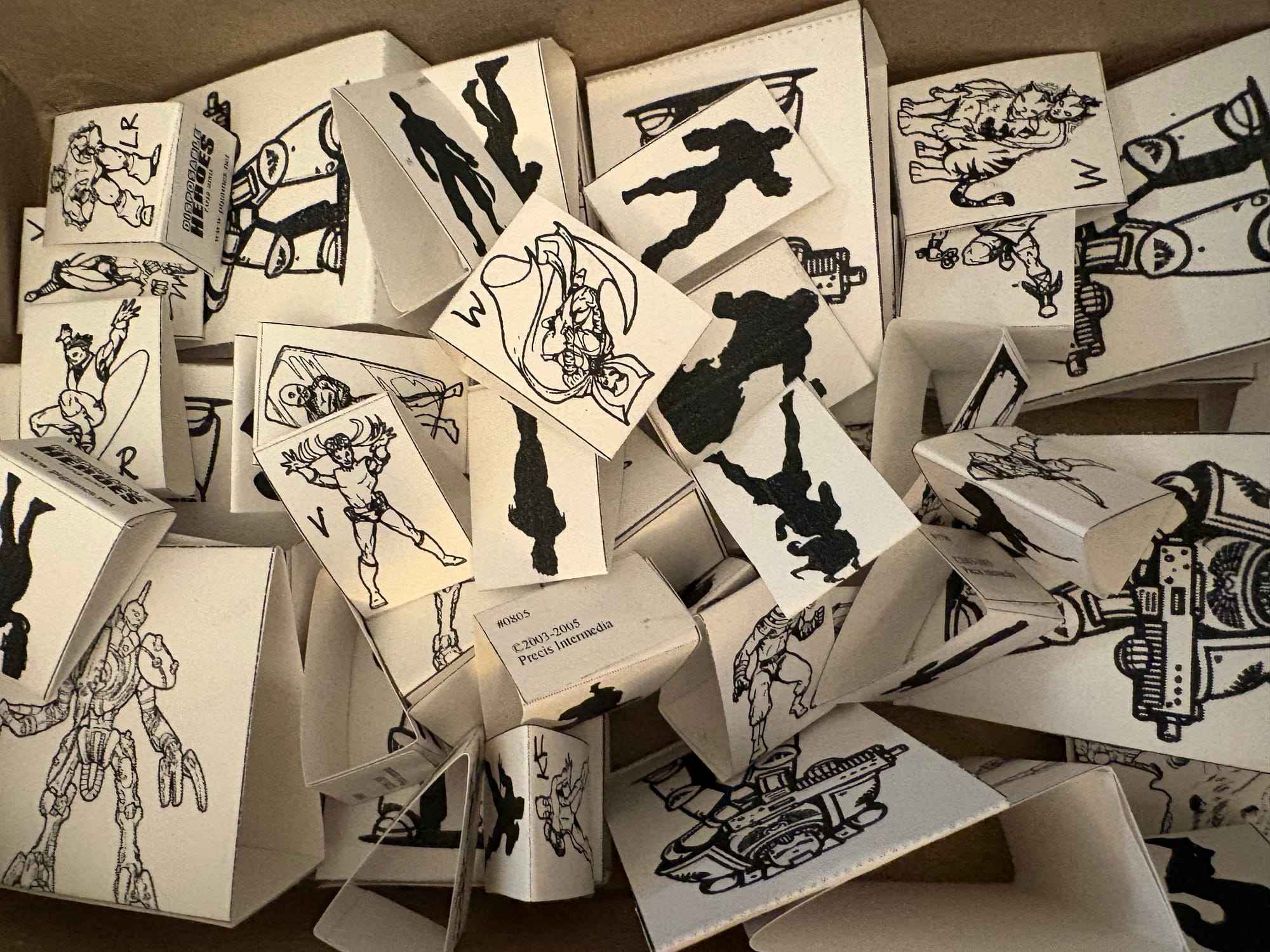
The generic pawns and paper minis are just two of the possible ways to represent things on a battle mat of course. My FDM 3D printer can’t print detailed, but it can produce all sorts of tokens. I have a frankly excessive supply of filament in different colors, and my printer's multi-material addon lets me do prints in up to 4 colors with relative ease. Detailed 1” minis are too much to ask of it, but tokens with clear markings are a breeze. My roommate uses an SLA/resin printer to supplement his Warhammer 40,000 armies though, and there are tons of printable models available. If I played any wargames, I’d probably conscript some of my miniature armies into these visualization exercises.
Obviously, nothing is going to be a total panacea for the challenges that creative writing can present, but I wanted to share a simple and fun tool that got me through a particular creative challenge, especially since I don’t normally get anywhere with those kinds of tools when writing.