A Cartoon Role-Playing Game

Despite David Zaslav’s best efforts, Coyote vs. Acme is getting a theatrical release this weekend. Discussing that with some friends led to the question of what kind of cultural cache the Looney Tunes franchise really has today. It started as a long and successful series of animated shorts, back when theaters used to show animated shorts before the main movie. As theaters dropped cartoon shorts from their offerings, Warner Bros. moved Looney Tunes to television, putting the shorts into half-hour programming blocks under names like The Bugs Bunny Show, The Bugs Bunny/Road Runner Show, and Looney Tunes on Nickelodeon. They also shut down the production of new Looney Tunes cartoons for multiple decades, basically until Tiny Toon Adventures launched in 1990.
WB increasingly used the characters for ads, and the public saw them shilling products more than anything for a while. 1996’s Space Jam was financially successful, critically panned, and kind of a glorified commercial. Newer releases have been mixed, but titles like The Looney Tunes Show (2011) and The Day the Earth Blew Up (2024) showed some real passion and creativity. Space Jam: A New Legacy (2021) on the other hand is one of the most cynical, corporate movies I’ve ever seen, and also just a bad film.
Regardless of what WB was doing with the characters, they’ve maintained a certain quietly intense mainstream appeal. They appear on shirts (both official and airbrushed at county fairs), tattoos, and baffling boomer memes on Facebook. They have massive name recognition, and they're surprisingly popular streaming titles on HBO Max and Tubi, albeit with an audience that skews heavily towards adults. Kids these days (get off my lawn) are more into algorithmic content on YouTube (though I have a friend whose daughter baffles her friends with Homestar Runner references), but adults of all ages still enjoy Looney Tunes. We’ll have to see how Coyote vs. Acme does at the box office regardless of its 96% on Rotten Tomatoes, but Looney Tunes has a durable place in the zeitgeist. Given that it now has an adult audience, CvA seems like exactly the right place to take the franchise.
The first TTRPG I ever played was Palladium’s licensed Robotech game, but the second, and the first one I ever owned, was Toon: The Cartoon Role-Playing Game from Steve Jackson Games. Specifically, I got the 208-page version from 1991, which compiled the four smaller books they’d originally published (Toon, Toon Silly Stuff, Son of Toon, and Toon Strikes Again) into a thick red paperback. At the time I was in the 7th Grade and cartoons were a major part of my mental landscape, one of the forms of television that I had a virtually unlimited appetite for. Looney Tunes, Tiny Toon Adventures, all the Disney Afternoon shows, Tom and Jerry, Pink Panther, and way too many more. I liked the newer stuff, but I had no compunctions about watching cartoons from decades past, even if they made some references that went over my head. Anime would later become a bigger obsession for me, but at the time I thought Toon was about the most amazing concept for an RPG there could possibly be. I got the book by special ordering it from a local B. Dalton, and I eventually got the three supplements (Tooniversal Tour Guide, Toon Tales, and Toon Ace Catalog) as they came out over the next few years. I distinctly remember a friend balking at how I had $80 worth of books for “a cartoon game,” but that was when we were mostly playing Rifts, so in hindsight it was a glass houses kind of thing.
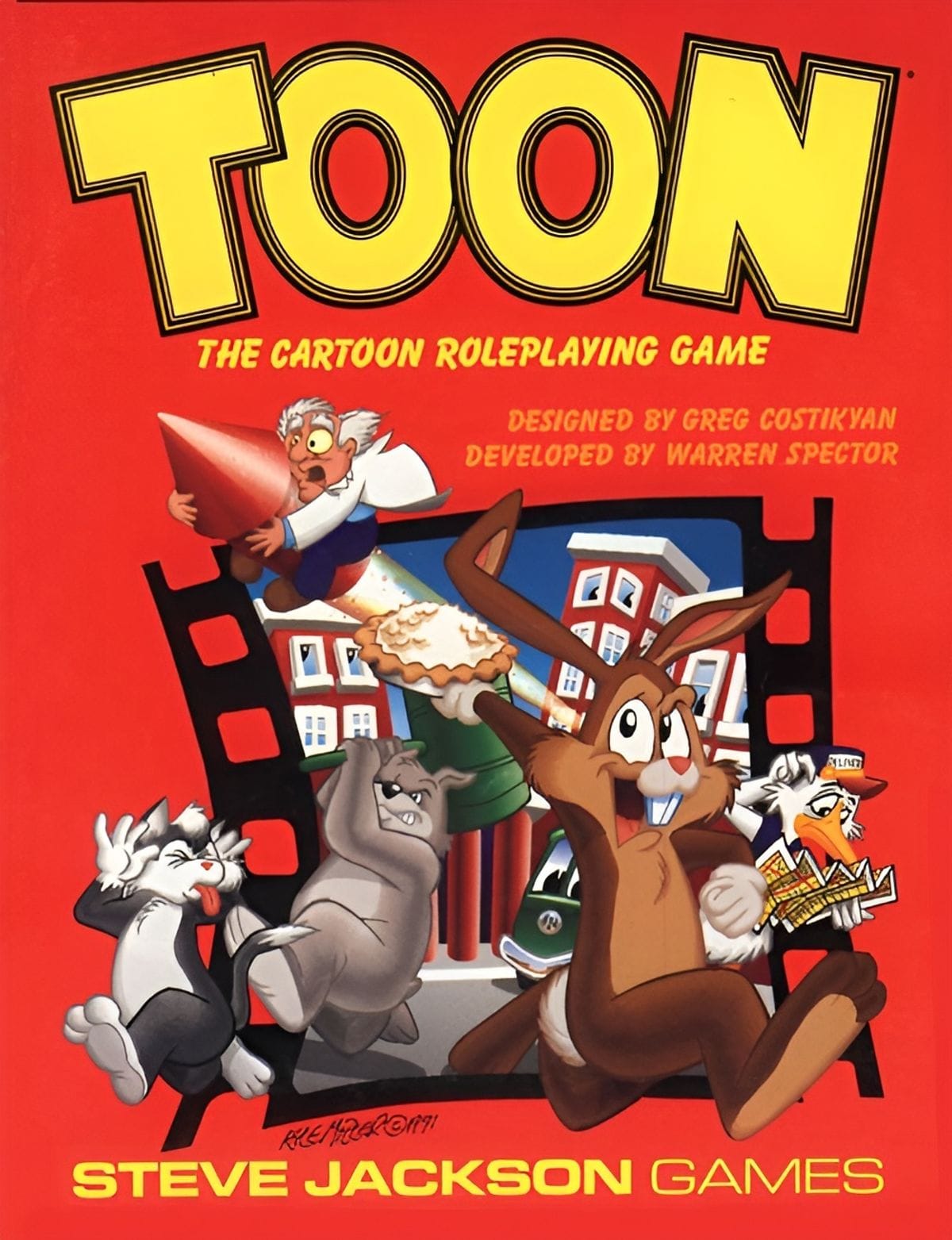
Toon originally came from Greg Costikyan, who also created Paranoia, a satirical dystopian TTRPG that mocked Cold War paranoia, something I wasn’t really equipped to fully appreciate at the time. Toon is more straightforward, and the biggest revelation I had later on was that it was essentially a very silly and simplified GURPS, with a surprising amount of mechanical similarities and the exact same graphic design conventions. Steve Jackson Games loves 8½x11” rulebooks with sidebars on most pages. It originally came out in 1984, when the medium of TTRPGs was only 10 years old, so it was a bit more innovative and revelatory than it might look today. A Toon character has Hit Points (1d6+6 of them), but when characters take enough damage to run out of HP, they simply “Fall Down” and get back up after three real-time minutes. At the time, TTRPGs that didn’t make character death possible were vanishingly rare, and games that made character death likely were pretty common. Genre emulation like Toon's falling down rules showed up in a few games like Call of Cthulhu and Teenagers From Outer Space, but they were the exception to the rule. Being truly innovative is genuinely difficult, and there’s a reason the designers of these games hold the stature they do.
Toon is now a bit over 40 years old, and Steve Jackson Games recently did a crowdfunding campaign for a Second Edition with Warren Spector returning to the game as well. The physical edition is going to be a hardcover that costs $79.99 by the way. The BackerKit page promises an updated system that runs even faster than the original, and the character sheet preview shows that they've pared down the selection of skills considerably. I don't know whether I'll go as far as to get a game together with friends, but I definitely want to at least get the PDF to see what they've done with it. I’ve resolutely kept my worn Toon books through the years, but I haven’t used them all that much. They remind me of my gaming roots, but I haven’t felt the need to actually do much of anything with them.
A few times over the years I’ve brainstormed ideas for TTRPGs that really stuck with me, refusing to dislodge from my brain until I figured out how to make them happen. When trying to think up possible Fudge-powered anime games for a potential publisher, I wrote down “Raspberry Heaven,” which eventually became a card-based slice of life schoolgirl story game that had nothing to do with Fudge. Visiting the Super 7 store in San Francisco's Japantown (sadly now long gone, though the company is still around) with its soft vinyl toys and other weirdness led to the title “Melancholy Kaiju,” which eventually became a surreal slice of life game about giant monsters in everyday life who feel kinda sad. They’re small, weird games, and they’re personal favorites among my designs. I still want to realize Distorted Futures: A Game of Dystopian Ass-Kicking (for action in the vein of The Matrix, Equilibrium, Ultraviolet, etc.) someday.
The discussion of Coyote vs. Acme inspired me to get back into working on I Hate You: A Cartoon Story Game For Two Good Friends. (I realized that having a game called “I Hate You” is setting myself up for some “Who’s on first?” nonsense, and I’m okay with that.) I had the idea to do a game that plays out “predator vs. prey” cartoons, like Wile E. Coyote and Road Runner or Elmer Fudd and Bugs Bunny. The “prey” character is an underdog trickster the audience roots for, and the “predator” is the antagonist who we want to see fail. (Though as a cat person I never liked how they normally cast cats in the villain role.) When I started seriously exploring the idea, I found that the predator vs. prey dynamic accounted for a huge portion of Looney Tunes shorts, along with a lot of the other cartoons from the golden age of American animation (roughly from the 1930s to the 1960s), from studios like MGM, Fleischer, and Hanna-Barbera.
I’d chosen a narrow slice of the possible stories, but a huge portion of those cartoons, with endless variations. (Hence Looney Tunes’ original run alone had about a thousand shorts.) Bugs Bunny is a clever trickster, Porky Pig is more of a naïve, good-natured hero, and Daffy Duck is kind of a jerk and can take either of the two roles depending on the particular cartoon. The cartoons often have contemporary settings, but they’ll regularly visit historical eras, outer space, and fantastical worlds. (They also could be pretty bad in terms of racial sensitivity at times, but mainstream America was like that in general.)
A while back I revisited Toon by running a session with some friends, to remind myself of what it’s really like in play. I really don’t want to insult a game that I got so much fun out of from designers I highly respect, but I kept thinking things like “cartoon characters don’t have hit points.” The typical Looney Tunes short has a series of scenes, and characters don't accumulate damage so much as suffer big hits that make the cartoon jump to a new scene. In Toon, characters have pretty low chances of success at rolls, with the justification that “failure is funny.” As I mentioned in my essay on humor, what’s funny is unexpected results, and characters failing as expected isn’t especially funny in itself. Whether a Looney Tunes character can succeed never feels random, and it mostly comes down to which side of the predator vs. prey formula they fall on. Since the prey character is an underdog and e.g., in real life coyotes are actually faster than roadrunners and eat them all the time, the formula itself has one of those benign violations that can foster humor. Toon is a benign violation of our expectations of what a TTRPG is like, and the Falling Down rules are one of the first thing people mention to explain how it's different from the norm for the medium.
While it has some interesting innovations, Toon really is a light, silly variation on GURPS, and its rules operate on that kind of logic. Success depends on randomness moderated by numbers on the character sheet and the judgments of the GM (which the game calls the Animator). Toon is fun as a role-playing game that plays out a bunch of cartoon tropes (and also parodies a lot of tabletop games), but it’s not a Looney Tunes simulator, any more than D&D is a Lord of the Rings simulator. I have a really hard time imagining Tex Avery having much use for maps for example, but several of the adventures in Toon have them, even if they’re simpler than you’d see in games like D&D or Call of Cthulhu.
Toon’s supplements were a bit mixed, with some overly complicated rules and so-so parodies. Building a robot character with a budget in dollars like you’re playing GURPS is a weird thing to put into a cartoon game, and having your stand-in for Captain Picard be a bald eagle named “Jean Nuke Pickacard” is… meh. The Toon Ace Catalog is essentially a collection of gags framed as items in a catalog, and it’s one of the stronger supplements. I Hate You is definitely its own animal, and its rules are going to be wildly different from those of Toon. Even in a relatively constrained genre, there’s a ton of room for TTRPGs to approach these cartoons in wildly different ways. Sanguine Productions also took a swing at cartoon role-playing with a nifty Powered by the Apocalypse game called MADCAP: Screwball Cartoon Role-Play, and Laura Adams’ game Moxie! is also PbtA, but downright minimalist in its approach.
Jason Morningstar’s Fiasco is a really fascinating game, and also a surprisingly delicate set of game mechanics that are hard to imitate or repurpose. It requires enough improv that it’s not for everyone, but with the right group it can be amazing at its stated mission of creating one-shot games that capture the feel of a Coen Brothers movie. Its release led to a flowering of playsets that let you play it in different settings (I made a few by the way), but few games that followed have much Fiasco in their DNA. I made a few attempts over the years, and they mostly fell flat. I Hate You is by far the most Fiasco-like TTRPG I’ve ever successfully designed, I think in part because it similarly benefits from rules that make it easier to stop worrying about your character’s fate in favor of creating something interesting. If you’re going to authentically play as your Original Character based on that one famous coyote, you really can’t be emotionally invested in the guy succeeding, because that’s not going to happen.
A session of I Hate You takes about half an hour to play out something in the vein of a 7-minute cartoon short. It’s divided into a series of scenes, during which the players take turn “tapping” traits. Wile E. Coyote uses his Mail Order trait to get rocket boots, and Road Runner uses the Coyote's "Fatal Flaws" disadvantage to have the boots send him on a wild ride. When the scene ends, they each roll a die and advance on a simple roll-and-move style board/VP track (with special effects on most of the spaces), and the scene’s outcome is based on comparing their die rolls. Road Runner rolled a 5 and Coyote rolled a 2, so we describe how the Coyote flies up into the air and plummets into a canyon before moving on to the next scene. Handling movement on the board and the scene outcome with the same die roll was one of those little moments that make game design really satisfying.
The cartoon ends when you either tap all of the characters’ traits 4 times each or one player reaches the 20th space on the board. Then you compare their relative positions on the board to determine how the cartoon ends, and that’s that. Character sheets have no numbers (or they may, but only if they also include some reference stuff for different die roll results), and the difference between Super Strength and Fast-Talk is basically flavor text.
The one aspect of Fiasco that I’ve found easy to port over to other games is its epilogue scenes, which are a great way to bring a session of play to a satisfying close. Melancholy Kaiju and Saving Throw both use that conceit, though in Saving Throw (my Chick Tract parody game), the epilogue has Eternal Consequences for the sinner character. I Hate You is a bit on rails, but so is its source material.
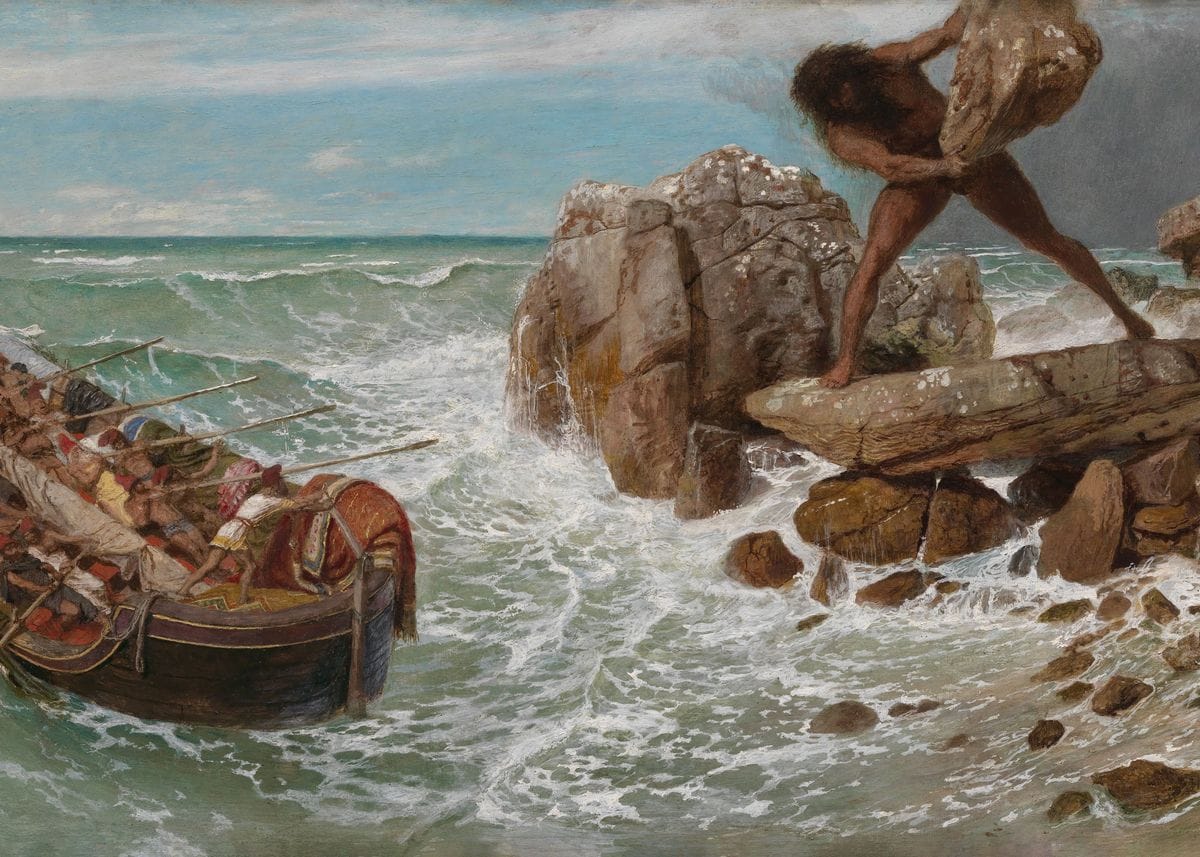
While rolling the concept around in my head, I also realized that you don’t have to stick strictly to Looney Tunes and its ilk. The “prey” character has a definite parallel to classic trickster archetypes, and you could pretty seamlessly use the rules for e.g. a more comedic take on Odysseus and Polyphemus (the cyclops). I wrote up some fairly standard cartoon characters as sample characters for the book (my favorite being Hannah Hunter and Dani the Deer, both of whom are influencers), but I also put together writeups for a superhero and supervillain (Killfile and The Overlord from my Xeroverse stories, which is to say parodies of Deadpool and Doctor Doom) and rival Japanese schoolgirls in the vein of Project A-ko.
I’ve said multiple times that comedy games shouldn’t be a bunch of lame jokes wrapped around bad game mechanics, and I’ve tried to live up that. I put some jokes in the text of I Hate You (readers will have to judge for themselves whether my jokes are any good), but I’m trying to prioritize clearly communicating the rules. While I have done some games like Kagegami High that have a lot of humor in the actual text, IHY is first and foremost a set of mechanics with some worked examples and added guidance. I haven’t been doing all that much in the way of TTRPG work of late, and it’s been great to get inspired like this. It genuinely feels like I’m reclaiming a part of myself I’d lost for a while, and I’m really looking forward to doing more playtesting.