Interpreted Chaos: Random Generation for Creators

Join my Patreon to get early access to posts, plus bonus material and a backlog of essays, fiction, and games!
I have the dubious honor of being the translator of Maid: The Role-Playing Game, the first Japanese TTRPG to be released in English. I did so because I thought it was a really fun game, though in hindsight I probably should have given it more thought and edited the manuscript better. It was a learning experience that left me better prepared to translate and publish Golden Sky Stories and helped my partner in crime Andy Kitkowski do a better job with the long-awaited Tenra Bansho Zero. Maid RPG also had a massive influence on me as a TTRPG designer, and to a lesser extent as a writer.
The vast majority of TTRPGs make use of dice rolls as a core part of gameplay. In D&D when you attack, you roll a 20-sided die to determine whether you manage to hit, and if successful, you then roll different dice to determine how many damage points the attack causes. Other games can use dice in different ways, and while fully non-random TTRPGs exist, they’re so different from the hobby’s baseline that they’re pretty rare and significantly harder to design. Maid RPG was something of a parody of the trend of maids in otaku fandom of the 2000s, and designer Ryo Kamiya embraced randomness more than basically any other game I’ve ever seen. There are vanishingly few ways to interact with its rules that don’t involve rolling dice in some way. D&D introduced randomness into character creation by having players roll for ability scores and HP, and it took a while for designers to figure out that chargen doesn’t have to be random. Maid RPG chargen on the other hand includes not only random stats, but a host of traits that hand you a fairly detailed character. In addition to generating some numbers, character creation involves several random tables that give you things like hair colors, weapons, personality traits, and so on. Random rolls in D&D may give you a fighter with an unusually high Wisdom, but random rolls in Maid can reveal that you’re playing a chainsaw-wielding cyborg mermaid out for revenge.
The random chaos not only doesn’t stop when you begin playing, but can ramp up in a big way. The game has a few different ways to run a game session, including using fairly conventional game sessions, but the most unique way to play is by letting random events drive the game. The book has a section with random tables that can produce all sorts of in-game events, divided into various genres and moods. Ninjas attack, the mansion turns into a giant robot, a massive storm rolls in, that kind of thing. The GM can opt to roll up a random event whenever they feel like it, and players have the option to spend points to add even more random events to the proceedings. The result is an incredibly frenetic, unpredictable, and fun kind of play, and a real challenge to the GM’s ability to improvise. It creates a very particular kind of play experience, and I’d occasionally watch a particularly random comedy anime (like Penguin Musume) and think, “This is running on the Maid RPG physics engine.”
I think of Maid as an exemplar of what I call “interpreted chaos,” where a random generator gives you a series of signifiers that you then shape into something coherent and hopefully worthwhile. Human beings are natural storytellers and pattern-matchers—it’s at the core of how we make sense of the world around us—so it plays to our strengths. A writer has to constantly come up with all kinds of details. While things like the established setting, the writer’s personal experiences, and doing research all figure into how we devise various details, random generation can be a powerful tool for both creating novel ideas and getting over various difficulties. Sometimes I need to carefully craft the perfect name for a character, but other times I need to just pick something already, and a random generator tuned for the culture or genre at hand can be a great way to do that.
There are a lot of random generators out there, and it’s not all that hard to make your own once you know how. Maid RPG uses a format common in Japanese TTRPGs called a “d66 roll.” To make a d66 roll, you take two six-sided dice, designate one as the tens digit and the other as the ones digit, so that when you roll them, you get one of 36 possibilities numbered 11 to 66. The simplest d66 table just has one entry for each number, but you can do things like have multiple columns (for first and last names for example), double up numbers (11-12, 13-14, etc.) to have only 18 possible results, or even add a hundreds digit (a “d666” roll) to have 216 possible results. Six-sided dice have the advantage of being very easy to come by, and 36 is a good midpoint in terms of the quantity of possible results, able to provide a good variety without straining the table-writer’s ability to think up entries.
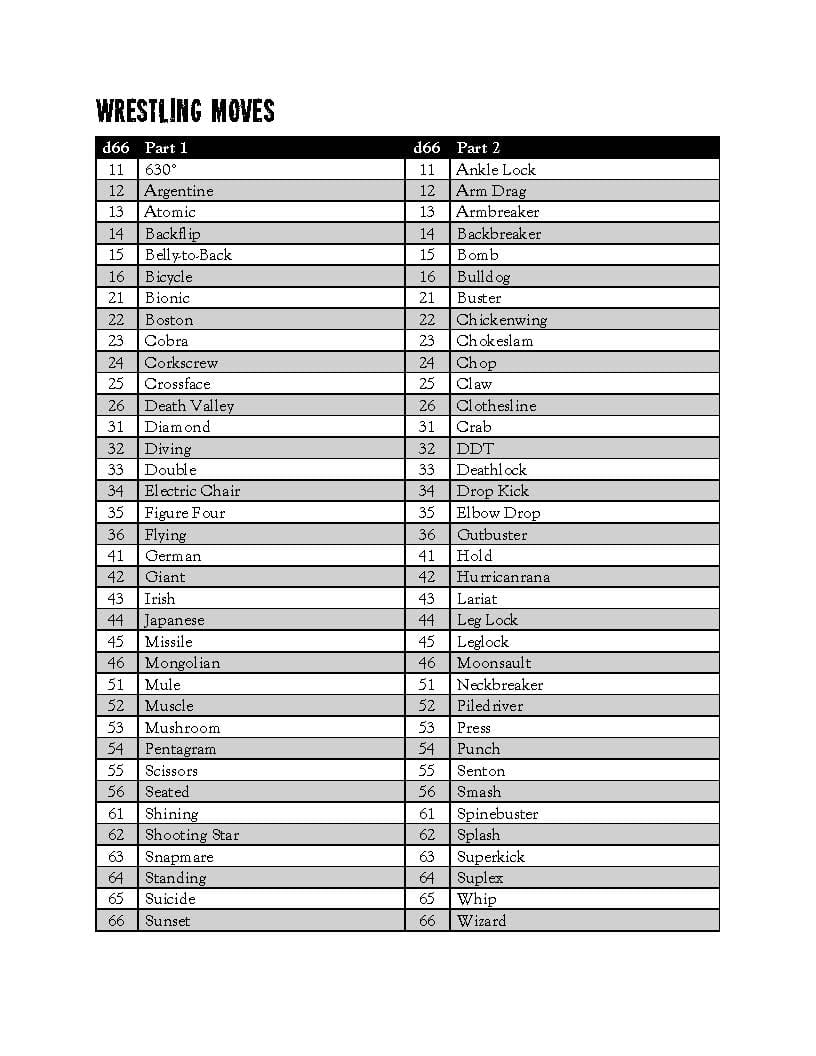
I’ve fallen off in recent years, but I did a long series of d66 tables for various subjects and genres called “Ewen’s Tables,” which is a handy resource for when I’m stumped. In the case of Memes of the Prophets, I even created some setting-specific tables for the Clan of the Shadow Blade, to make it easier to come up with more of the weirdos obsessed with impractical magic swords. I’ll still have to think up some other details, but knowing that a guy is (rolls some dice) “Rugal Machinus, the Supersonic Firebrand of House Sandrunner” gives me a lot to work with.
Needless to say, I’m far from the only person to make random generators that can be useful to writers:
- I’ll leave it to you to decide if there’s anything mystical about tarot cards and similar forms of divination. I’m skeptic personally, but I think they still have value for their ability to spur ideas and conversations. People have imbued tarot cards with enough meaning that there are whole books on them, but the Tarotorial deck from Raven and Rogue has brief summaries on each card, making them much easier for novices to interpret.
- Dungeons & Dragons has included random tables to varying degrees across its many incarnations. Maid’s Random Events owe a debt to D&D’s Random Encounters (where characters run into monsters or NPCs, with tables tuned to particular environments and locations), and D&D rulebooks (as well as third-party supplements) have included all sorts of tables for generating things like character details, treasures, terrain, spell effects, etc. D&D mostly uses a percentile roll, using two ten-sided dice to generate a result from 1 to 100, though its tables often had ranges of numbers assigned to a single result so that the designer didn’t have to come up with a hundred different entries. While I favor d66 tables, the specific dice only matter insofar as they serve what you’re doing.
- Rory’s Story Cubes are six-sided dice, each with a symbol of some kind, intended to spur creativity or be the basis of a game in their own right. There are multiple packs based around different themes (and of course some imitators), but they’re all very easy to put to use and wide open to interpretation.
- Seventh Sanctum is a website chock full of random generators by my friend Steven Savage. He’s been running the site for several years now, and has covered countless genres and topics.
- Lee’s Lists is a prolific collection of lists and random tables, and one of the major inspirations for Ewen’s Tables.
- The Metamorphica is a book with a massive collection of tables of various kinds of “mutations,” ranging from odd physical traits to magical phenomena, with additional tables for using them in various ways.
- Itras By is a Norwegian surrealist TTRPG that uses two decks of cards in play. Its Resolution Cards serve to resolve conflicts with simple, story-oriented descriptors like “Yes, and…” and “No, but…,” while its Chance Cards provide events that help reinforce its surreal feel, like “Haunted by the Past!” and “Do Not Gaze Into the Abyss.” The Resolution Cards are an inheritance from another game called Archipelago, and in general the Norwegian scene favors bits of content on cards to help drive play.
How much I’d use random generators for a given piece of writing really depends on the specific type of writing I’m doing. For an all-out comedy that specifically aims to be as random as possible, random tables would be my best option, whereas for something more serious and grounded I’d only use them sparingly.
Have you used any random generators in your own projects? If so, how did you use them, and how did it work out?
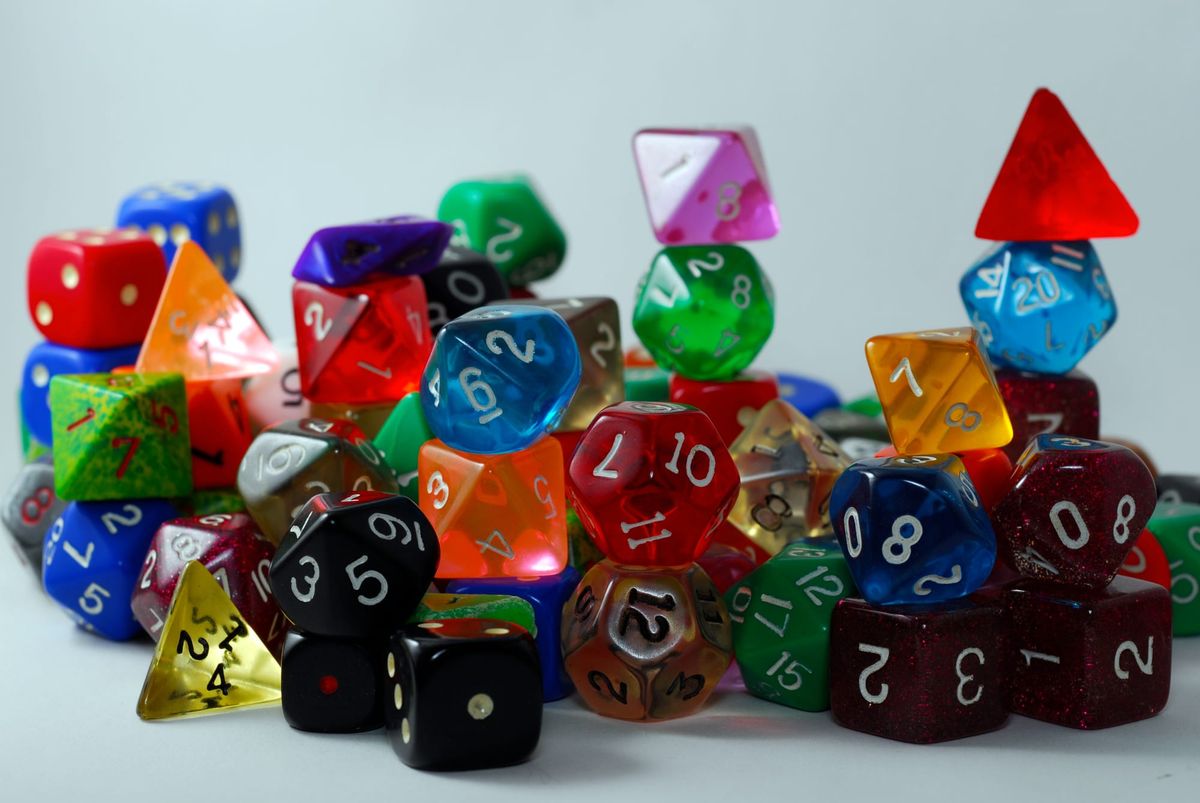
Header image is by JB, used under a Creative Commons-Attribution license.