
Enshittification

For the past two years and some change I’ve been working from home and not socializing in-person nearly as much as I’d like. When my day job presented the opportunity to switch to a new team that would work from a nearby office, I was actually excited about it. They’ve since been taking their time about it, blowing past the original start date by several months (so far), so it’s harder to stay excited about it, even if I got the pay raise regardless. I’ve realized that one component of my somewhat frayed mental health is that right now technology defines my life, and although computers are more sophisticated than ever, there’s a distinct mediocrity and frustration pervading today’s tech. When no one is around I tend to catch myself yelling at misbehaving inanimate objects, which isn’t ideal in a lot of ways. My set of catchphrases for this purpose has evolved over time, but currently it goes:
- Why are you like this?!
- Stop being terrible!
- Stop being awful!
- What are you DOING?!
- DON’T BE F***ING STUPID!
- Not that hard!
- Still not that hard!
- STILL not that hard!
- When did this become a problem?!
I do need to find better ways to deal with my frustration, but if you’ve used much in the way of contemporary tech, chances are it’s all very relatable. Stuff works, until it doesn’t, usually for no discernible reason. Once the major operating systems switched to NT and Linux kernels, they got a lot more stable than they were in the 1990s, but these days problems do crop up, and they feel random and often baffling. I use an M1 MacBook Air for a laptop and an Asus desktop running Windows 10, and sometimes I’m glad I have both because some things simply refuse to work on one or the other. There are certain USB devices that my MacBook refuses to admit exists for no apparent reason, and I recently had to reinstall Windows 10 from scratch because it just sort of forgot how to use Wi-Fi and there was simply no fix.
Part of the issue is that I’m enough of an electronics hobbyist to get into some oddball projects with spotty documentation and support, but some of it is representative of big industry trends. Somewhere along the line, computers got opaquer about what they’re doing. Of all the various computers I use, I think only my Raspberry Pi has never made me ask the question, “Is this update taking a long time, or did it brick my device?” Windows has the spinning dots that can go on an inordinately long time, and most Apple devices have black screens and progress bars that sometimes don’t seem to move. Linux shows you every single thing it does as it installs updates, until lines of text blur by, so an update’s progress is never in doubt. A lot of stuff syncs over the internet, and they’ve largely stopped letting the user press a “Sync Now” button in favor of the app doing it whenever it feels like getting around to it. I could go on listing pet peeves (the really big one being that you can’t really buy software anymore), but the fact remains that despite hardware becoming more powerful, some stuff just got worse.
Tech also just isn’t that exciting these days. While smartphone manufacturers have tried a few things that flopped—a phone with a tiny projector built in, one with a massive camera lens, a curved screen, and whatever the LG Wing was, to name a few—they’ve pretty much abandoned big swings. Now smartphones are basically all minor variations on the same black rectangle that Steve Jobs demanded, and for the average user, the differences between Android and iOS aren’t all that big. (They can be night and day for power users of course.) The Apple Vision Pro was probably the first piece of tech to come along in a while that felt like something new without being a new scam or hype bubble, and it was very expensive while lacking the polish you’d expect from an Apple product. Ed Zitron, probably the most cynical tech commentator I know of, thinks it has potential, so clearly Apple is onto something, but it remains to be seen if future iterations can sufficiently improve on it to justify the $3,500 price tag. The need for something new and exciting has helped create bubbles around web3, NFTs (remember those?), the “metaverse,” and now generative AI, all of which have lit billions of dollars on fire. There are countless reasons to not use generative AI, but right now it’s as close as the entire tech field has to something new. Instead, the biggest innovations from Big Tech are mostly in things that they know better than to crow over.
In 2022 Cory Doctorow observed a phenomenon that he called “enshittification,” where websites tend to start serving users, then harm users in favor of business customers, then finally screw over the business customers in favor of themselves and shareholders. Facebook is probably the most glaring example. It started off… Well, it started off as a creepy site for rating how attractive you find people, but it caught on when it became a social media site for college kids, then for everyone. From there it started putting more and more ads into users’ feeds, and then they started screwing over advertisers to make themselves more money. If you as a user decide to follow a business’ page, instead of just showing you their posts when they make them, Facebook shakes them down for money to “boost” posts so they actually appear on your timeline consistently. That’s nowhere near the worst thing Facebook has subjected advertisers to either. The whole “pivot to video” fiasco was based on a lie, and it killed some worthwhile websites. When I look at my own Facebook feed today (I have a lot of friends and family on there), it barely has anything to do with the people and pages that I’ve actually chosen to follow, and I know I’m nowhere near the only one having that experience. Facebook the company has been flailing around trying to find the Next Big Thing, betting so big on the Metaverse that they rebranded as Meta, and later getting in on generative AI. Late-stage capitalism doesn’t allow a company to simply be sustainable; it has to keep growing forever. You know, the thing that cancer tries to do.
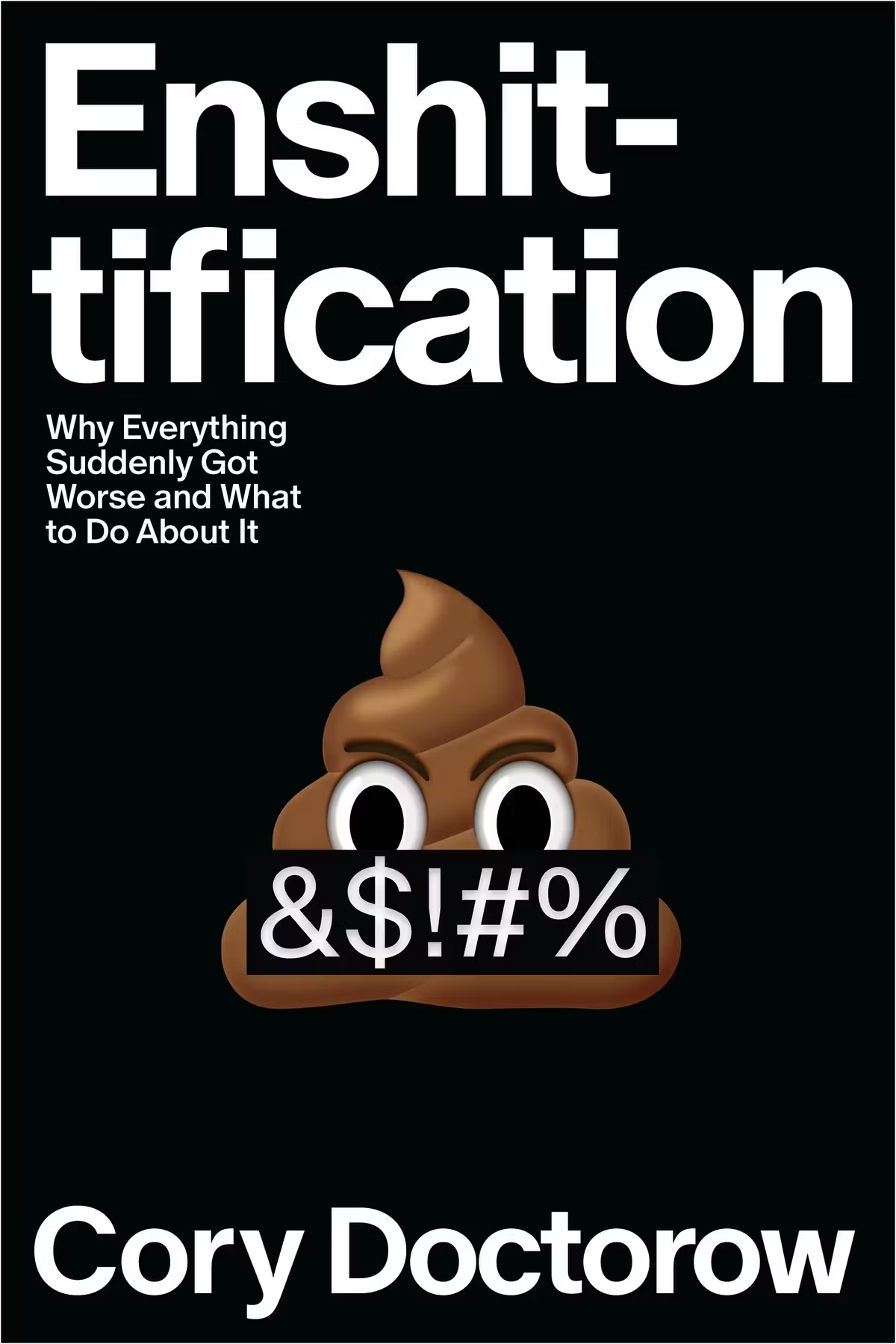
Doctorow recently released a new book called Enshittification, which discusses the topic in detail and provides a mixture of success stories and potential solutions. It’s a timely and accessible book, and one that ends on a hopeful note. Shit sucks right now, but we have the power to fix it, and people have already started doing so. The book is also something of an object lesson in its subject matter, since Doctorow was adamant that the audiobook should be available without DRM, something that Audible—which has locked down most of the audiobook market—absolutely refuses, regardless of the wishes of authors or publishers. He thus gave up a significant amount of personal income to launch the audiobook through a Kickstarter and make it available in a DRM-free format. Amazon, following the enshittification pattern, is terrible to sellers and horrific towards its own employees. There are politicians who I want to ask why they hate America, but with Jeff Bezos I want to ask what it is he so despises about the wellbeing of virtually all fellow human beings.
A while back I was thinking about distraction-free writing tools. I like the idea of having a thing with an e-ink display and a keyboard, but dedicated writing devices tend to be either expensive commercial products or poorly documented open-source projects. The Pomera looks neat but costs $500, and thanks to the state of the Bill of Materials, I couldn’t figure out how to source all the parts for a Micro Journal. Then the phrase “Android e-ink tablet” popped into my head. That led to buying an Onyx Boox Go 6 e-reader (for about $150), which fit the bill for writing, but also wound up being an excellent replacement for my Kindle. For writing I installed the Microsoft Word app (I’ve been looking for a replacement without a subscription, but no luck so far), and since I’m a mechanical keyboard weirdo I have entirely too many keyboards I can use with it. I find it oddly refreshing to use, because it cuts out a lot of the nonsense and distraction of both Kindles and using a full-on computer for writing. I was able to install the Kindle app to get at my existing Kindle library, but I can also just drop e-book files into it and start reading them. Its OS doesn’t show me any ads either, because Onyx International is a smaller company that just makes quality hardware for you to use as you see fit. I was able to install F-Droid (a “store” for free open-source Android software) and KOReader (an open-source e-reader app) very easily, and where my Kindle’s lock screen is a succession of ads, the Boox lets me pick my own, hence it now displays an assortment of Memes of the Prophets art. Despite Big Tech’s best efforts, it’s still possible to get things like the Boox e-readers, though of course you have to go a bit off the beaten path. Even Micro Center—which recently made a triumphant return to Silicon Valley—only has basic Kindle e-readers, nestled among the Android tablets. (OTOH, Kindles are relatively easy to jailbreak, which lets you install new apps and even run Linux.)

Enshittification is ultimately a manifestation of monopolization, coupled with abuses of IP law. In America, politicians of both parties have participated in the erosion of antitrust laws and labor protections over the past 50+ years, which has allowed companies like Apple, Amazon, Google, and of course Microsoft to grow to monopolistic proportions. We rightly oppose monopolies because competition forces companies to try to make better, cheaper products, pay their workers better, and generally act as businesses rather than feudal lords. Enshittification is the process of tightening the screws after a platform has made itself indispensable, and it’s a great reason to stop letting these companies make themselves indispensable.
Alternatives exist, but for the most part if you need a smartphone (and realistically, most people do), you’re stuck with the Android/iOS duopoly. (Worldwide Android represents about 75% of smartphone users, though that’s partly just because Android phones can be significantly more affordable for people in poorer countries.) If you want a Linux phone, you’ll be one of a small number of people trying to order online, probably from an odd corner of Europe. If you go for practically any other kind of phone, basic functions like texting will likely be significantly more difficult. Apple markets itself as respecting users’ privacy more, but in practice they just prefer to spy on users themselves rather than opening the doors for everyone to do it. They also use their leverage to take a 30% cut of all sales made of and through iOS apps, which is ten times more than any normal payment processor. It’s rare for Elon Musk to complain about something actually legitimate, though he managed to make it sound like he hadn’t heard or cared about Apple’s fees before they became an issue for Twitter.
If you want a smartphone that’s ethically made, you don’t have a lot of options. Apple infamously has iPhones made at Foxconn factories in China where they push workers so hard that they have nets to prevent suicides, but the factories that churn out phones for Samsung and their ilk aren’t any better. One site I came across rated smartphone manufacturers on ethics. On that site virtually every smartphone manufacturer failed an ethics review, with Nokia barely passing (the brand now does entirely unremarkable Android phones) and Fairphone (a Dutch company that emphasizes fair trade and sustainability) the only one with a good rating.
Even if you’re callous enough to not care about the plight of Chinese factory workers, enshittification affects the end user too. Texting used to use SMS, which did the job but was terrible in terms of security. SMS messages are shockingly easy to intercept, fake, etc. Apple introduced iMessage, which provides a superior messaging experience with vastly better security, specifically between Apple devices. I have a friend with an iPhone, and I can seamlessly text her from my phone, MacBook, iPad, Apple Watch, or even HomePod. (Yes, I have too much Apple junk around.) iMessage messages are encrypted, and they can be longer and have various enhancements. It’s a great example of Apple’s pursuit of better tech benefiting customers overall. The rest of the industry created the RCS (Rich Communication Services) standard so they wouldn’t be left behind, and Android phones now have a messaging feature comparable to iMessage. Apple dragged their feet on implementing RCS essentially as a gambit to get iPhone users to pressure their friends to also use iPhones. Most of my friends use Android phones, but I would never tell them they’re using the wrong mobile OS, and they’ve never objected to my iPhones in turn. (What kind of freak would do that?) Tim Cook (who by the way oversaw Apple’s transition to using Foxconn’s suicide-inducing factories before he became Steve Jobs’ successor) famously told an interviewer that if he wanted better messaging with his mom, he should have his mom get an iPhone. I’m guessing that interview convinced some people to switch to Android instead. For a long time if an iPhone user messaged someone with a non-iOS smartphone, it would be via SMS, thus exposing every Apple customer who has friends who aren’t Apple customers to all of SMS’ security vulnerabilities. They did finally implement RCS in iOS in 2024 (so about 7 or 8 years late), though they still have segregated green and blue text bubbles to remind you who is and isn’t in the Cool Kid’s Club.
This isn’t anywhere near an issue with tech alone. Monopolies, cartels, and enshittification are infecting countless industries, abandoning fair and reasonable business practices in favor of squeezing and harming everyone but the shareholders and executives. The Worse on Purpose blog/newsletter chronicles the phenomenon in different industries, and it's always fascinating and depressing in equal measure. Technological enforcement isn’t required for that kind of naked greed, but it certainly makes it easier. Amazon is a hideous company that’s harder than ever to avoid, and one that’s dominated every form of books, with DRM to lock people into their digital offerings. A small number of regional cartels have taken over chicken farming in the U.S., and they squeeze farmers so much that it’s a wonder any chicken meat gets sold at all. Amazon, still not done being unethical, similarly abuses the companies they subcontract for deliveries. Driving a semi used to be a pretty decent career, and now truck drivers have to deal with predatory loans and excessive workloads that risk the safety of the drivers and everyone around them. People who do honest work are being forced into lives of precarious poverty simply because corporate sociopaths want to extract more money every step of the way. The list goes on and on, all in the name of making the number go up. There’s a sickness in corporate culture, and even more so in American corporate culture, and enshittification has become one of its favorite tools.
Even when there is healthy competition, these days an entire industry will often go the enshittification route at the same time. If you want a car that doesn’t spy on you, there simply aren’t any options in new cars. (The Slate, a small, affordable, customizable electric pickup, may become a glaring exception once it launches.) Stuff that was originally foisted on people with criminal records and poor people under predatory loans is now standard, yet another arm of the data harvesting panopticon. Relatively few car makers have gone as far as to demand subscription fees to use features already installed in cars—unsurprisingly, Tesla was a pioneer of that kind of thing—but respectable brands like BMW have done so. If you want a non-enshittified car that just drives and doesn’t spy on you or anyone else, your only real option is a fairly old used car, which means dealing with countless other issues. California now requires auto makers to let customers opt out of their spyware, showing how this is a deliberate choice made by corporate sociopaths and not an intrinsic property of the technology. Thankfully I was able to get Ford to comply for my Fusion without any trouble, but the fact that spying on customers the assumed default (and something they can switch on or off remotely) is worrying. (Yet another side issue I’ll pass over here is how the entire automotive industry truly sucks at doing software, which is a problem when everyone has an infotainment unit that can malfunction and distract them while driving.)
Enshittification is an artificial phenomenon. Computers are everywhere, and they’re Turing-complete. A given computer may not be able to run some programs because they don’t have enough RAM to handle it or peripherals it genuinely needs, but broadly speaking any given computer can run basically any given piece of code with enough work. There’s a reason people have gotten Doom to run on practically anything. It’s not that an iPhone can’t handle alternative app stores or apps that Apple doesn’t approve of, it’s that Apple is artificially stopping you. iPods weren’t as tightly locked down as iPhones, but rather than a sensible file system, they required you to sync your entire collection through iTunes, presumably to corral more people into a widely derided app that integrates their digital music store. Currently, Android allows you to install your own .apk files and whole alternative app stores, but Google had announced that they’re planning remove the ability to sideload apps, killing the openness that helped distinguish Android from iOS. The backlash from users over this “security” feature got it changed to requiring developer verification regardless of how you install an app, but that’s still blatant enshittification. Apple’s anti-repair “parts pairing” that interferes with the ability to do things like replace a damaged display is something Apple’s engineers had to go out of their way to create, since it’s not at all a natural property of a pocket computer. I’m sure it wouldn’t be a massive amount, but I have to wonder how much cheaper an iPhone would be if they hadn’t put all that effort into anti-consumer tech.
There are people and companies trying to produce non-enshittified smartphones and smartphone operating systems, but right now they’re tiny niches. There are some flavors of Linux made specifically for smartphones like SailfishOS, as well as privacy-focused Android variants like /e/OS and GrapheneOS, though compatibility with phones varies wildly. Apple likes to crow about how a much larger portion of their userbase is up to date with the current OS than for Android, and for better or for worse whether a phone can handle a given version of Android is pretty much up to the individual manufacturer. Having read that Nokia was the least unethical mainstream phone manufacturer, I bought a $100 Nokia C210 to mess with. (It’s definitely a $100 smartphone, but overall it’s fine. It’s good to know that if my iPhone suddenly dies I’ll have a backup ready to go.) It runs Android 13, and since Nokia isn’t bothering to update it anymore, updating it to Android 14 or later is simply not something I can do. It’s probably possible, but would take a fair amount of work by someone with specialized technical skills. Since I just upgraded to an iPhone 16, I won’t be buying another smartphone for a while, but I’m seriously considering making my next one an Android phone that I can customize with a better OS, say a used Pixel. Fairphone is also good in terms of compatibility with custom ROMs, but would require importing the phone from Europe.
Some things are hard to enshittify. I recently got into manual typewriters, and I now own both an Olivetti Valentine and a Remington Quiet-Riter. They’re a bit bulky and loud, and correcting mistakes is difficult, but they’re good for my writing in that they lack the distractions of typing on a modern, internet-connected computer. The unique feel, the aesthetic stylings of these machines, and their general analog-ness constitute a lot of the appeal for me, but they’re also highly resistant to enshittification. Repairs can be an issue—the few surviving typewriter repair shops have taken to cannibalizing old machines for replacement parts—but it’s not like Olivetti can suddenly decide that my Valentine needs a subscription model, generative AI integration, ads, or any of the other bullshit that creeps into a lot of digital stuff. The Valentine launched in 1969, though mine is a Japanese model (hence it has a Yen symbol) made in Barcelona, probably in the 70s. The Remington meanwhile was made in the 1950s. Both required some maintenance, but they nonetheless work just fine decades later. That is not the case for computer or smartphones. One of the ways Fairphone is distinguishing itself is by promising seven years of OS updates, along with easily installed replacement parts. That seven years is significantly longer than the average smartphone lifespan of 2-4 years, but I have a typewriter in good working order that’s old enough to collect Social Security.

I’ve now owned a total of five iPhones over the years, and with one exception (my iPhone 7 Plus started coming apart), the upgrades have essentially been because the battery wore out and the software became too resource intensive. The former would be easy to fix in a device that isn’t hostile to repairs (I was shocked that it was so easy to replace the batteries in my AirTags), and the latter would be fine if it were easier to keep using older versions. I sometimes buy cheap junk from AliExpress, despite knowing that it’s at least as ethically dubious as my more mainstream gadgets. But as dishonest as fly by night AliExpress sellers can be, they lack the viciousness and rent-seeking of enshittified late-stage capitalism. A Chinese brand with too many consonants may sell you a rooted Android device that doesn’t really look like the pictures on the site, but after that they’re done with you, and won’t try to force you into a subscription. They may not encourage you to repair it when it breaks, but they aren’t fighting tooth and nail against non-approved repairmen either.
TTRPGs don’t lend themselves to enshittification because so much about them is dependent on the people at the table. If Wizards of the Coast suddenly decided to only make D&D available via a tightly restricted app, you could just continue playing with your printed books and PDFs, or (gasp) switch to one of the countless other games out there that lack the clout to try that shit. Edition changes do at times seem to have ulterior motives attached, but the most obvious example of enshittification I can think of is what happened to the Character Builder for 4th Edition. I had a lot of fun playing 4e with my friends, but the game did have the ulterior motive of creating a more video game-like business model, including the D&D Insider subscription service. The Character Builder made it vastly easier to handle the game’s endless character options, and it got regular updates for new books and magazine articles, making it by far the most useful aspect of the subscription. It was originally an application you installed on your Windows machine, and it could store any number of character files locally. One major limitation it had however was that there wasn’t a good way to implement your own game material. WotC had reluctantly provided a semi-open license for publishing 4th Edition material, but didn’t provide any way to get that material into the app a massive chunk of players were using to make characters. Where 3rd Edition’s open license helped birth new publishers that are still around today (most notably Green Ronin), even the most talented creators of 4th Edition material found they couldn’t sell much. Getting into all the issues with the OGL and GSL could be a whole other essay though (and a topic I’ve already written about at length), so let’s move on.
At some point, someone at WotC decided they didn’t like how people were sharing subscriptions and pirating the software, so they redid the CB as an online service using Microsoft Silverlight. They did this after months of silence and failing to update the existing Character Builder, which at the time was incredibly annoying since I was trying to run a Dark Sun campaign. At launch it was buggy to the point of barely working, but even after they made some fixes, it was more limited in important ways. You could only store so many characters on your account, and it was online-only in an era when wireless internet wasn’t as ubiquitous. The result was worse for everyone except possibly WotC (and maybe a few people using OS X or Ubuntu), and there’s a reason Microsoft dropped Silverlight entirely. Fans kept the offline Character Builder alive, using piracy and the fact that the Silverlight version used the same data format to create something that was better than the official version. They even went as far as to implement a bunch third-party and fan-made game material in the app.
There’s a niche but vocal trend for retro tech now, which has people going back to devices from the early 2000s or before. Having lived through the Bush years it’s harder for me to wax nostalgic about that bizarre period of history, but the current state of things does make it feel better in comparison. In the 2000s, we were still figuring a lot of things about technology out, and computers couldn’t really spare the processing power or budget to implement the more egregious forms of enshittification we see today. A Discman, Gameboy Advance, or cassette player dodges most of those problems, and they’re also just kinda neat. Cassettes are seeing a revival in part just because they’re cheap to have made. Bands that can’t afford to get vinyl records pressed can instead sell tapes, providing fans with their music in a tangible form. And if you want some classics, you can go on adventures at thrift stores and antique shops. If that still isn’t enough, there are a small number of new, mainstream releases on cassette as well. The mainstream of music consumption is still in Spotify and YouTube—which give artists pathetically tiny payouts—but people are starting to miss physical media. Being able to stream your music and other media is convenient, but there’s a lot to be said for holding it in your hands and keeping it for however long the physical object survives rather than as long as your subscription continues. Even in digital form there’s something to be said for being able to just download the files and do what you want with them, hence iPods and other mp3 players are also seeing a bit of a revival.
A major pillar of the current enshittification is technology that artificially limits what devices can do and IP laws protecting that tech. It’s possible to “jailbreak” an iPhone or Kindle to let the user make fuller use of its actual capabilities, but under U.S. law, sharing tools for such is a felony. As Doctorow put it, there are harsher penalties for removing the DRM from a book than for shoplifting a physical copy, and possibly even for hijacking a truck full of physical copies. There are technically some carve-outs for jailbreaking certain types of important devices, but there isn’t a carve-out for sharing the tools for doing so. Per the law, they supposedly expect any blind person who wants to transfer Kindle books to a braille reader to crack it themselves and not share the results with anyone. Which really means that the carve-outs aren’t meant to be used and the solicitations for comment are meaningless busywork. This kind of thing is obnoxious on smartphones, but it gets downright predatory on things like tractors (which farmers require to do their jobs), and monstrous when it comes to medical devices and implants. People who got vision implants attached to their optic nerves have been left in the cold (and dark) because the company behind them reflexively enshittified and then went out of business.
Doctorow’s book isn’t all doom and gloom thankfully. A large portion of it covers recent victories and a path to creating a “new, good internet” that resists enshittification. While the internet and new technologies require new approaches that match current realities (for example, requiring Mastodon-style federation so social media sites can’t lock users in), reclaiming the antitrust regulations and labor power that we used to have will do a whole lot. Tech workers have flexed their power in major ways at times, such as when Googlers had a walkout over the company’s clandestine plans to get into defense contracting. Their power has eroded—corporations hate when workers have power after all—and the company now has a small army of “contractors” and “vendors” who have substantially worse pay and benefits. People who work in Amazon’s offices still have problems—there have been reports of people crying at their desks from stress being a regular occurrence—but the corporation’s sociopathic ethos desperately wants to treat them more like the badly abused Amazon warehouse and delivery workers. If they have their way, Amazon’s coders may also be peeing in bottles.
One of the few silver linings of Trump’s bizarre and likely illegal trade war is that it undercuts the IP regime that the U.S. has forced on most of the world. That sharing certain repair methods is a felony is something the government made a condition of having proper trade relations with the U.S., and Trump is making a lot of countries ask whether they really need that in the first place. Countries that opt to drop the IP laws forced on them by American bureaucrats stand to gain, as interoperability tools not only take unearned power away from Big Tech, but create whole new markets for those tools, ones that won’t have much competition from within the U.S. until something changes here.
Big Tech’s hugeness can be a vulnerability too, in that when enough governments force them to do something, it becomes impractical to make separate, worse versions for different markets. When the EU forced Apple to start using USB-C instead of their proprietary Lightning ports on smartphones (a switch they’d already made on their other devices anyway!), it wasn’t worth it to them to make separate USB-C iPhones for Europe just to sell more Lightning cables. Furthermore, when one country puts together a case for reining in Big Tech, it generates research that other countries can use, causing a domino effect. While the U.S. Congress is unlikely to gather the political will to try anything like that any time soon, we could see so much of the rest of the world doing so that we could benefit anyway.
Making the internet and technology work for us rather than for Make Number Go Up isn’t the most important thing in the world—not when genocides are happening and climate catastrophe is looming—but restoring the promise of the internet will give us powerful tools for dealing with those problems. In Capitalist Realism, a major part of Mark Fisher’s prescription for fixing things is simply to have governments be more responsive to the will of the people. America’s Founding Fathers were skeptical of normal people, and saddled us with “safeguards” against the common man having too much of a say (and also left us the ticking time bomb of the slavery issue), but today opinion polling consistently shows that people want a better world and politicians are standing in the way. (Watch how establishment Democrats and their Labour counterparts in the UK lose their goddamn minds when an actual progressive is poised to win a significant election.) There are ordinary people who oppose things like worker’s rights and the right to repair (hardcore Apple fans can be weirdly defensive about Apple’s abuses), but they’re in the minority by a comfortable margin.
Right to repair laws have been proposed in numerous jurisdictions, and tech companies have always lobbied extremely hard against them, making all sorts of pathetic excuses for what amounts to a shakedown of their customers and an anti-environmental initiative in the name of further padding their profits. For the vast majority of human history, it was understood that if you buy something, it’s yours to modify, use, lend, and resell as you see fit. I’m reminded of Banksy’s famous quote about advertising:
“Any advert in a public space that gives you no choice whether you see it or not is yours. It’s yours to take, re-arrange and re-use. You can do whatever you like with it. Asking for permission is like asking to keep a rock someone just threw at your head.”
If a company sells me a computer, that’s my damn computer, and I’ll use it how I want. They don’t get a say. Societies and governments should serve the people, and corporations should be afraid to do things that harm the people. They’ve conned us into believing it’s their world rather than ours.