You Shall Become One of Them: Fletcher Hanks and Stardust

There are several reasons why Japanese manga and American comics are so different. Cultural differences are a major factor of course, but these two forms of sequential art also developed independently and under different circumstances. Manga grew out of printing techniques that date back centuries and became both thoroughly mainstream in Japan and capable of supporting countless genres aimed at every demographic and interest. There are multiple manga magazines just for men who play mahjong. American comics in contrast evolved from pulp magazines, such that they began as trashy entertainment for kids (mostly boys), sold at newsstands starting in the 1930s. Despite that, comics were a lucrative business (for the bosses at least), and numerous publishers sprang up as this new medium took shape. This was around the time of World War II, hence many of the industry’s founders and luminaries served in the war.
The fact that early comics were mainly sold to kids made them vulnerable when psychologist Fredric Wertham launched a moral panic about their effects on the youth. (Having learned a little more about him, we need to balance his panic-mongering with his antiracism when evaluating his role in history.) Some comics did have salacious content that even today most parents wouldn’t want their kids to see, but at the time the idea of comics for mature readers seemingly wasn’t something people were capable of comprehending. That led to the Comics Code Authority and a mass extinction of comics publishers, which eventually resulted in the Marvel/DC duopoly. DC in particular bought IP from defunct publishers several times, hence the DC Universe is even more of a patchwork of disparate elements than its Marvel counterpart.
Teen comics aimed at girls held on longer than the crime and horror comics that were the main focus of Wertham’s ire, but for a time the mainstream of American comics was essentially all superhero stuff. (With Archie Comics building an oddly resilient niche for themselves.) The switch from newsstands to the “direct market”—which is to say, selling through dedicated comic shops—kept the industry afloat, but meant that their comics were mainly sold in places that could be downright hostile to women. American comics thus became almost exclusively a hobby for guys, but that distribution model set Marvel and DC up for other publishers to outflank them by selling manga and other types of comics through bookstores.
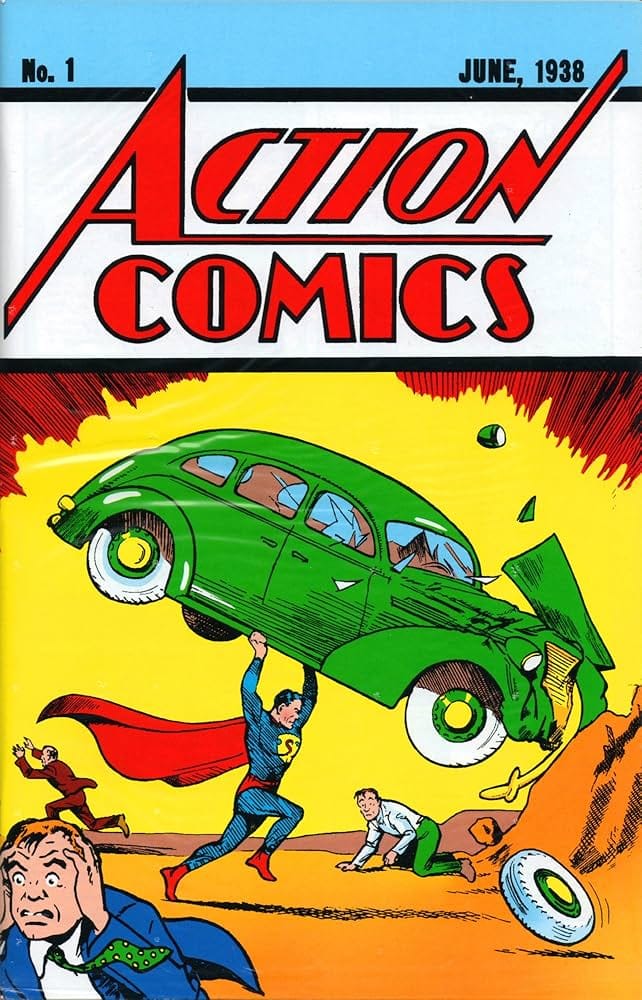
The “Golden Age” of comics was from 1938 to 1956, with Action Comics #1’s launch of Superman as the inciting incident. The comics of that time were unsophisticated to be sure, but there was a raw strangeness and creativity about them that remains fascinating. Early American comics grew out of pulps, so comic books were often anthologies of several different stories out of pulp genres. Superman got top billing in Action Comics #1, but readers were also treated to the wild west heroics of Chuck Dawson, the mystical heroism of Zatara Master Magician, and seven other titles.
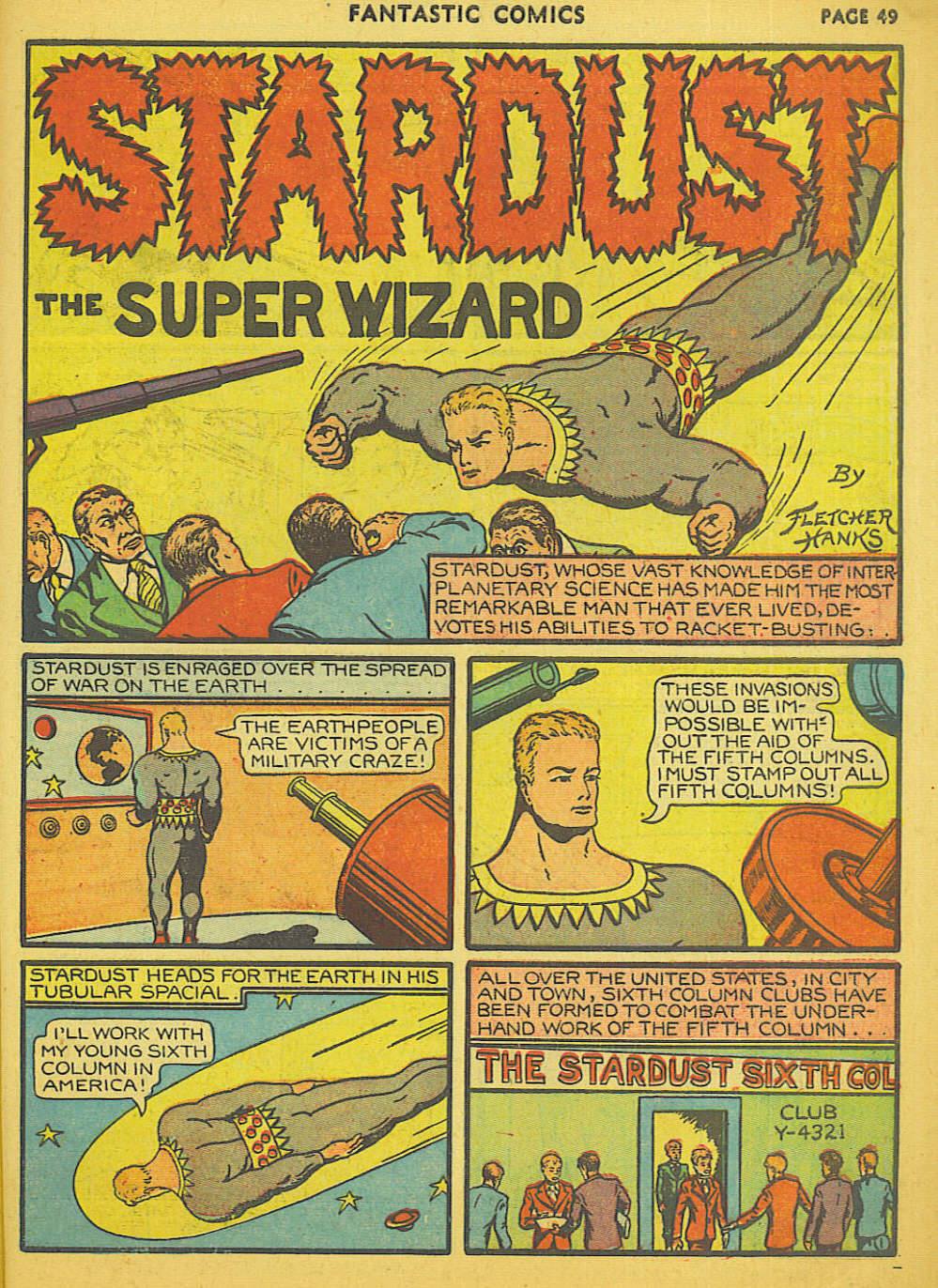
Fox Features Syndicate was one of the publishers of sleazy comics that the era of the Comics Code would kill off, though some of their characters, like Blue Beetle and Phantom Lady, lived on by way of sales to other publishers. Their first attempt at a take on Superman was Will Eisner’s Wonder Man. Although Wonder Man got his powers from a ring he received from a Tibetan monk, he was still similar enough to Superman for DC to launch the first lawsuit in the American comics industry. Wonder Man’s only appearance was thus in Wonder Comics #1. (At the time, comic anthologies called "[Something] Comics" were very common.) Superheroes were a big deal though, and the company had another go in Fantastic Comics #1. The cover features Samson, a superhero who is a descendant of the Biblical Samson, but near the end of the book is the debut of Fletcher Hanks’ Stardust the Super Wizard, one of the stranger superheroes to arrive in 1939.
Stardust has no secret identity, no normal name. He’s a massively tall and muscular man in a powder blue spandex (“starmetal”) outfit, with an oddly small head even by the standards of Hanks’ strangely proportioned characters. His powers come from vague super-science (or “interplanetary science”), and he dedicates his life to “crime-busting” “on the planets.” Each Stardust story follows essentially the same formula. A bad guy (who usually has an army of henchmen) is doing something utterly unconscionable—shutting off earth’s gravity, destroying all the oxygen, sending a fleet of terrorist gangster bomber planes to attack the US—and Stardust arrives to stop them and deliver strange and cruel punishments. Where Superman prefers to deliver villains to jail or in extreme cases the Phantom Zone, Stardust will do things like transform the bad guys into rats and unleash a hungry wildcat on them. There’s no nuance and very little variation across the seventeen Stardust stories published. He’s essentially the concept of punishment made flesh. Grant Morrison has compared superheroes to gods, but Stardust truly feels like a creature of myth, with no attempt made to humanize him. Stardust isn’t the only comic title Fletcher Hanks did though.
- Fantastic Comics #1 also includes a story about Space Smith, a raygun-wielding space hero with a copilot/girlfriend named Dianna. It bears the signature of Hank Christy, one of Hanks’ many pseudonyms, but the style is unmistakable. It also has a recurring theme of ugly aliens attempting to transform Space and/or Dianna into their kind. It’s an oddly specific trope, made stranger by how Stardust and some of Hanks’ other characters have used such transformations as righteous punishments. In either case, “becoming one of those wretches” comes off as a deep-seated fear on Hanks’ part.
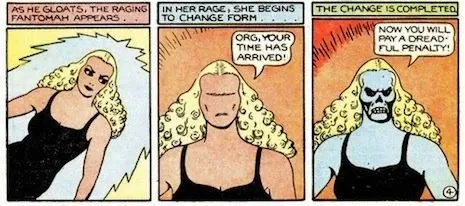
- His Fantomah character is arguably the very first female superhero. She’s a blonde woman who serves as protector of the jungle, wielding mystical powers and an ability to turn into a skull-faced banshee (or sometimes a floating skull?) to destroy those who would defile the jungle. Particularly given the time period when these comics were coming out, it’s intriguing how Fantomah routinely makes “the white man” its villains, the hunters and looters who were often heroes in pulp stories. Hanks depicted the jungle natives as simple and innocent African villagers (and occasionally inhabitants of sorta Middle Eastern cities) in dire need of Fantomah’s protection. While his infantilizing of native peoples isn’t ideal, it’s less bad than the common pulp depictions of dangerous “savages.” Fantomah was part of a genre of “jungle girl” stories, a specialty of publisher Fiction House and their Jungle Comics anthology title. Most jungle girl characters were more like either a damsel in distress or a female Tarzan, whereas Fantomah is the jungle girl equivalent of Stardust.
- Big Red McLane meanwhile is just a big lumberjack who uses his fists to deal with scoundrels who’d cause trouble in his lumber camp. He punishes the bad guys simply by punching them until they stop stealing lumber, but the story formula is essentially the same.
- The handful of other characters he did, like Whirlwind Carter and Tiger Hart, also follow the same simple story beats, where bad guys try to do something bad, and the hero stops and punishes them. A few of his comics got clandestine reprints under different titles, such as when a comic about “Big Red McLane, King of the Northwoods” became a comic about “Ted Kane, King of the Northwoods” by coloring in the character’s hair and changing some Rs into Ts.
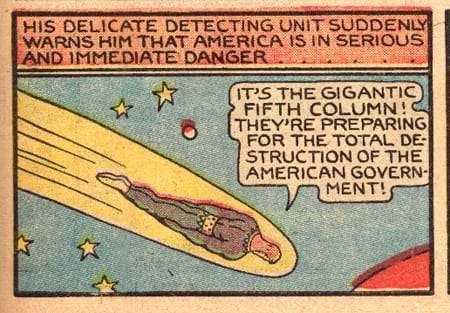
Where early Superman’s focus is on helping common people—an innocent woman being executed, an abused housewife—Hanks’ heroes mete out punishments like vengeful gods. Stardust is less Superman and more like the Old Testament God (as some Christians imagine Him; Jewish interpretations are more nuanced), and while Stardust is supposedly a guy using exceedingly advanced technology, there’s very little humanity in him. I have to wonder if the fact that Hanks’ father was a Methodist minister had something to do with it. Fantomah is a bit more about protecting her jungle and its inhabitants, but she barely even speaks to them. Instead, her dialogue is mostly dire pronouncements delivered to the villains who come to despoil “the jungle.” Also, since Hanks was working during World War II, both Stardust and Fantomah thwarted massive operations by the “fifth column,” ill-defined Axis sympathizers that were a hot topic in popular culture of the time. Such sympathizers did exist of course, but not to the absurd degree that Hanks imagined for his comics. Stardust went as far as to create a Sixth Column of patriotic boys, who he later equipped with powder blue starmetal unitards like he wears. It’s one of the creepier things in Hanks’ comics.
Manga artists generally have teams of assistants, especially for big titles that come out weekly. Mangaka for Shonen Jump titles can easily have a dozen or more assistants handling inking, screentone, lettering, and the other more menial parts of the process. For better or for worse they hardly ever reveal the names of those assistants, though assistants can work their way up to doing their own titles. American comics generally divide the work up between different specialist tasks: writing, pencils, inks, colors, and lettering, and (thanks to Stan Lee setting the precedent in defiance of how DC did things) each will receive a credit. Whatever else he was, Fletcher Hanks was a comics machine, one of the few people who did the entire production by himself (though it does appear that his work occasionally got touch-ups to fix the more egregious issues). The result has the definite feel of something rushed and probably made up as he went along. It’s not unusual for the final page of one of his comics to have twice as many panels as previous pages, as he seemingly struggled to fit everything in. Since these stories were only around seven pages each, instead of a denouement there would sometimes be a speech bubble pointing to a planet or skyline saying something like, “Stardust has saved the day!” It also has a bit of the feel of a radio play, with narration of the action in captions above more panels than not.
I think the language of Hanks’ comics is one of the most interesting things about them. It’s so stiff and odd that it’s simply not how people talk, yet it gives us some wonderfully bizarre lines:
- Turn loose our death rays and kill them all!
- You shall die by your own evil creation!
- You are now in the power of Stardust!
- The planes immediately curl into distorted and useless wrecks.
- The air is so pure, and so full of vitamins, you will live to great age!
- He’s making artificial creatures out of chemicals!
- You are partners! Partners in death!
- He’s surely produced a violent chemical! The madman is clever!
- That’s “Slant-Eye” and his gang! All tough babies!
- I must save that gold!
- He is planning to invade and conquer the jungle with hypnotized reptiles!
- I’ll develop a powerful sixth column to combat their underhand work!
- Before long, he has selected a great army of red-blooded boys who would like to do something for their country.
- You shall become one of them, and eat mud and fire for the rest of your days!
- Gravity is being destroyed!
- Grucko!
- Some fiend is planning to wreck the civilized planets!
- I shall destroy all the civilized planets!
- We’ll ram it hard!
- We must end democracy and civilization forever!
- I shall transform you into one man!
That last one is an example of one of the most unique things in Hanks’ comics. Stardust and Fantomah will both occasionally combine a group of bad guys into a single man and then proceed to punish him. A story that gets inside the head of a man who has the combined memories, knowledge, and personality traits of a dozen or more men sounds really interesting, but of course Fletcher Hanks isn’t doing that.
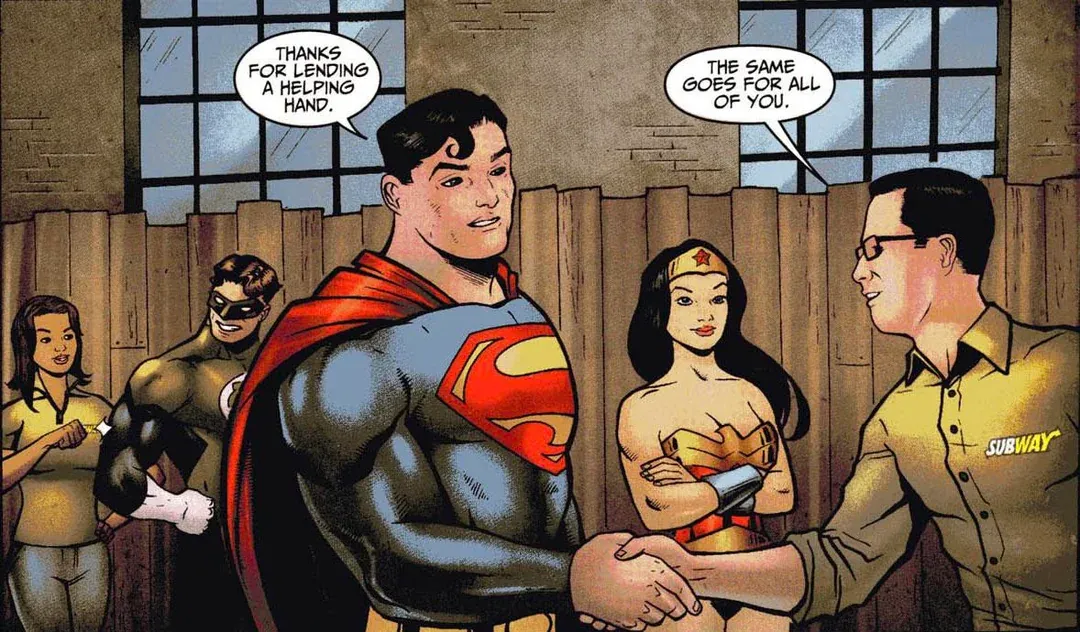
There really is something fascinating about the works of Fletcher Hanks. They’re the comic book equivalent of films like Plan 9 From Outer Space or The Room, definitely not quality entertainment in any conventional sense, but bad in an intriguing and entertaining way. The Room is terrible at being the Tennessee Williams drama that Tommy Wiseau was aiming for, but chances are if you watch it, before long you’ll be annoying your friends by saying, “Oh hi Mark.” When people complain about specific superhero comics, it’s usually some combination of poor execution and wrongheaded ideas, with results that are simply unpleasant to read. There have been unwanted Watchmen prequels and sequels, ill-advised cross-promotions (including an infamous comic that featured Jared from Subway), and the giant mess that was the short-lived Marville. Rarely do you see a superhero comic that falls into the “so bad it’s good” category, whereas if you’re into that kind of thing it’s easy to rattle off movies like Troll 2 and Samurai Cop.
The above list of quotes illustrates how the use of language is one of the things that make Hanks’ work so odd. Some of the dialogue in Plan 9 From Outer Space reflects that it’s a movie from 1959, but when Criswell says, “Future events such as these will affect you in the future,” we can’t put the blame on the zeitgeist. Similarly, while being from 1939-1941 definitely informs Hanks’ comics, most of the weirdness comes straight from him. There are occasional spelling and grammar errors, but also generally stiff prose and odd word choices. Stardust has a “private star” on which he has his “crime-busting laboratory,” and when he spots trouble he flies at incredible speed with his “tubular spacial.” Hanks regularly juxtaposes quirky sci-fi nonsense, the stiff language of a 1930s public service announcement, and the vocabulary of the Three Stooges. I don’t expect realism from superhero comics, but even by the standards of comics, Hanks had odd ideas about things like rays, vitamins, and chemicals, not to mention the English language. I also enjoy how Fantomah uses “jungle” as an adjective, telling bad guys that they’ll meet a jungle fate or die a jungle death for their crimes against the jungle-born. Hanks’ image of the jungle is both vague and expansive.
Cartoonist Paul Karasik’s fascination with the works of Fletcher Hanks led him to try to learn more about the man himself. It turned out Hanks was completely terrible as a human being. His son, Fletcher Hanks Jr., related how the man was an abusive alcoholic, to the point where everyone in the family was relieved when he ran out on them. He took all the money too, though according to Fletcher Jr., his mother said, “It’s a small price to pay to be rid of the bum.” Hanks later found a wealthy woman who was willing to support him, so he abandoned his work too. In 1976 he turned up frozen to death on a park bench in New York. Dying like that is heartbreaking, but he’d abused and alienated his family so badly that they were glad he was gone.
His comics thus weren’t the work of a tortured genius, but rather what an alcoholic scumbag threw together to pay for more booze. The extreme punishments he gave his comic book villains feel like an echo of his own enraged overreactions to every little thing that annoyed him at home. In contrast, Siegel and Shuster were geeky Jewish guys and sons of immigrants, and in Superman they created a champion of the downtrodden. Since Hanks’ comics are in the public domain, Karasik spearheaded Fantagraphics’ publication of restored collections of those comics, plus a short original comic chronicling his meeting with Hanks’ son. Karasik also learned that Hanks picked up cartooning via a correspondence course, and he’s capable of significantly better art than what appears in the comics he cranked out.
The brief period when Hanks was working in comics lasted from 1939 to 1941, so his work is about 85 years old as of this writing. That was before the end of WW2, before the Vietnam War and the Civil Rights Act, and decades before even the most nascent form of the internet. People argue back and forth about representation in works of fiction, but it’s hard to overstate just how much it was assumed that the hero of any given story was going to be a white guy. Stardust, Space Smith, Big Red, and most of Hanks’ other characters fall into American archetypes of heroes of Western civilization. Big Red is carving out a kind of civilization on the frontier, Stardust ruthlessly maintains a status quo, and Space Smith protects Earth from belligerent Martians. Hanks doesn’t depict his heroes violently quelling brown people who misbehave though; his villains are also Caucasian like his heroes, though much uglier. (With the possible exception of a gangster called… ugh… “Slant-Eye.”)
But then there’s Fantomah, protector of the jungle, whose enemies are first and foremost ambitious white men who would take the jungle’s treasures and enslave or slaughter its people. It was a far cry from the kinds of narratives we would get once POC were better able to tell their own stories, but for 1940 it was unusually progressive. Of course, given that Fantomah was Hanks’ take on the “jungle girl” genre for publication in Jungle Comics, there’s a distinct possibility that the character was ultimately just what he came up with to meet the publisher’s criteria, but it feels like there’s something more going on. He definitely put a bit more effort into drawing Fantomah, and her Hollywood starlet face and figure don’t get nearly as wonky as with Hanks’ male heroes.
The 1990 Dick Tracy film had a lot of ambition, a star-studded cast, and an attempt at the kind of comic-inspired visual style that 300 (2006) and Sin City (2005) would better achieve, but it was a resounding flop. Disney were hoping they could repeat what Warner Bros. had done with Tim Burton’s Batman, so the film received an all-out marketing campaign, with Happy Meals, commercials, and an immense amount of merchandise. Like Godzilla (1998) and Wild Wild West (1999), it was one of those movies where the people in charge of the marketing were vastly overestimating how much audiences would care.
Re-airing an older take on the media receiving an update was also a common tactic, and they aired reruns of the 1961 The Dick Tracy Show cartoon. (With a few episodes omitted for being racially insensitive.) As a kid who watched a ton of cartoons, I tuned in, but before long I realized that every single episode followed the exact same formula. Even Tom and Jerry mixes things up more. While story structures can be a genuine help to writers, some stories lean on them so hard that the whole thing collapses. Dick Tracy is the (formerly) mainstream comic most similar to the works of Fletcher Hanks, and it’s not a compliment to either side of the comparison. Japanese magical girl and sentai shows often fall into a “monster of the week” format, but even when every fight ends with the same finishing move, these manage to vary their stories a lot more than you ever see in Stardust the Super Wizard or Dick Tracy.
Updating either Dick Tracy or Stardust for today’s audiences is an odd proposition. Warren Beatty (who is currently 88 years old) is still clinging to the rights to Dick Tracy—hence the television specials in 2010 and 2023—but people aren’t exactly clamoring for more material from 1930s comic strips. (Alley Oop and Li’l Abner haven’t seen revivals either.) An updated Dick Tracy would essentially be a hardboiled detective story with a yellow trenchcoat, and its success would derive more from the quality of the new work than name recognition. Stardust resists even that, because even for a Golden Age superhero, he’s so lacking in nuance and humanity. There were signs of the things that would ensure Superman’s longevity even in Action Comics #1, the way he has very human compassion backed up by superhuman powers. Stardust was only ever exactly one thing, so moving away from Hanks’ story formula means moving away from the only things established about the character. If Stardust isn’t a vengeful god, there isn’t really anything there, and you’re left with a generic hero free of both weaknesses and personality. Fantomah in contrast passed on to different comic artists in 1941, so she got away from Hanks’ simplistic storytelling early on, albeit with multiple retcons that substantially changed her backstory and abilities.
I’ve been thinking about this—and I bought a copy of Turn Loose Our Death Rays and Kill Them All—because I’m planning to include Stardust in the fourth Xeroverse book, the one where the protagonist’s reality starts to really fall apart. Stardust represents an old, raw, strange form of superhero from the dawn of the genre, and he brings a cruel, absolute kind of justice that stands in stark contrast to the human melodrama of Fantastic Four and X-Men. Xero sometimes has trouble fitting in with the world of movie superheroes because he’s more compassionate than most, and Stardust goes to the opposite extreme more than even the most Zack Snyder of heroes. Asking for Stardust’s help fending off an existential threat to Earth is probably going to be the biggest mistake Xero ever makes. I am of course nowhere near the first person to have the idea to use Stardust in a new story.
In the 2000s, Image Comics did a short-lived “Next Issue Project,” where they took old comic anthology titles and had contemporary creators produce new stories with those characters. It began with 2008’s Fantastic Comics #24, which among several others, includes a new Stardust story written by Joe Keatinge and illustrated by Mike Allred. In a story in Fantastic Comics #12, Stardust rescues an unnamed young woman, one of the very rare instances of him interacting with normal people. Since she’d lost everyone to the villains’ machinations, he took her back to his private star. The new story catches up with her years later. Stardust left to protect other planets, and on Earth, robots took over from superheroes. It turns out that the robots are actually suits placed on enslaved superheroes, and when Stardust returns, he uses a ray to make the woman young again and sets about the work of restoring the world of heroes he’d left behind.
League of Extraordinary Gentlemen: Century meanwhile included a frozen Stardust as a sadistic interstellar vigilante captured at last. Captain Universe was able to defeat Stardust because Stardust was drunk (a clear reference to Fletcher Hanks’ real-life alcoholism), and his own chamber of a freezing concoction put him in an eternally frozen state (not unlike how Hanks died). The frozen Stardust of course has the bizarre proportions of a Fletcher Hanks hero.
Hanks’ other characters are much easier to imagine updates to, though some feel more worthwhile than others. Space Smith is generic retro sci-fi in the vein of Buck Rodgers and Flash Gordon, and Big Red is a lumberjack who punches bad guys. Fantomah on the other hand has potential as essentially a female Ghost Rider. A small publisher called Chapterhouse put out a Fantomah comic where a young woman named Paz Gallegos returns from the dead as Fantomah to take revenge on the gang that killed her. That version is going to be the basis of a TV series, though there isn’t a lot of information about how the production is going. Stardust is in a curious position where his strangeness and public domain status make him tempting for creators, but his essential characteristics make him hard to use, plus his relative obscurity means that he isn’t a big draw. There are a lot of public domain superheroes out there, but for now they’re generally little-known characters that creators should be using because they find those characters compelling, not because of name recognition.