The Ewen Method: How I Write Fiction

For whatever reason I had the idea to try to explain my creative process, I think as much for myself as anyone else. I don’t have a lot to say about the nitty gritty of how to put sentences together, and this is more about the overall shape of the process. Since this is a creative, artistic endeavor, your approach may be so wildly different that my advice is useless to you, but feel free to comment about your own experiences!
Principles
The post-apocalyptic TTRPG Apocalypse World introduced a concept of stated “principles.” These aren’t ironclad rules, but they serve as guideposts to help the participants achieve the intended style of play. I’ve done similar things in some of my own TTRPGs, and here I’m going to try to articulate the principles I follow when writing fiction.
- Respect the reader. When you put out a book, you’re asking people to give you some of their hard-earned money and precious time. Don’t pander, but do show them respect. Give them your best, and try to give them something unique.
- Care about the characters. George R.R. Martin has killed off a lot of his characters, but you can nonetheless tell he cares about them. He gives even minor characters interiority, even ones that aren’t going to survive very long. If you don’t care about your characters, you would anyone else?
- Learn from poetry. The thing that helped my prose the most was taking two semesters of poetry writing classes in college. Writing poetry teaches you about several aspects of the written word, including things like symbolism and the sonic flow of words. While free verse is now dominant in poetry, formal poetry (i.e., poetry that uses forms, like sonnets, haiku, etc.) teaches you more about poetic devices like meter and rhyme, which can still play a role in prose.
- Be honest. My minor in creative writing also introduced me to Dean Paschal’s short story collection By the Light of the Jukebox, which taught me the lesson that I need to be honest, to use my lived experiences and inner thoughts as a key part of how I create. Paschal takes his experiences as an ER doctor, his sexuality, and other real-life inspirations and makes them into fodder for some truly intense and surreal stories. Even—especially—if you write about far-flung fantastical worlds, your own life can still give you inspiration for the characters’ inner and outer lives. That’s likely where you’ll be at your best as a writer.
- Seek out feedback. Fiction books aren’t as interactive as games, but they’re at their best when they can be part of a conversation rather than a tome offered from on high. A writer needs other people for the process to even make sense, and it’s at its best when you can get good feedback that makes your work stronger.
Concept
My creative projects always start with an overall concept, an idea that I find myself wanting to realize. Sometimes it hits me out of nowhere, sometimes someone suggests something, and sometimes I deliberately sit down to brainstorm. Usually the idea forms on its own over time.
There’s a saying that ideas are a dime a dozen, and the real value is in the execution. I’m not sure that’s completely right, in that for me good ideas for stories take time to form, but it is true that by itself, an idea doesn’t mean all that much. The execution is a process, and I’ve always had to devise and discover a lot along the way to realizing my idea. That’s one of the great joys of writing though!
Unfocused Writing
When I start writing, it’s usually in a flailing, unfocused kind of way. For a novel, I’ll typically write an opening scene and whatever other bits and pieces of the story forming in my head are really speaking to me. This kind of writing is more spontaneous, and it helps me better understand what I’m doing. I often end up making major changes to stuff I write this way—and sometimes discarding portions entirely—but it’s proven to be an important part of the process. If I can just step in and type up a few thousand words off the dome, I probably have something worth pursuing, and even if I never come back to it, at the very least I got in some writing practice. At this stage I’m practically freewriting, maybe even getting close to surrealist automatism.
Research and Inspiration
It’s rare for me to pursue a creative project without at least some research, even if it’s just watching something in the same general vein. I find it helpful to have a grasp of what came before, and nonfiction books can give a writer a better understanding of the topics at hand, as well as general vibes. With my Xeroverse stories, I’ve learned a ton about superheroes and the industries around them from books like MCU: The Reign of Marvel Studios and Disguised as Clark Kent: Jews, Comics, and the Creation of the Superhero, which helped enrich the story and let it better tackle real-life issues. The Myth of the American Superhero meanwhile helped me better understand the broader questions of how American culture formulates heroism, and books like Jesus and John Wayne and Cowboy Apocalypse brought home the effects that formulation has on us.
The specific content of this research will vary wildly depending on the specific project, as does the amount. Memes of the Prophets has taken on enough of a life of its own that I’m not getting a lot from other isekai stories anymore, whereas the Xeroverse novels are so grounded in the realities of the superhero genre that they demand a deluge of input to maintain a deluge of allusions and symbolism.
Initial Planning
In fiction writing there’s a divide between people who thoroughly outline stories ahead of time and people who write by the seat of their pants. I’ve tried all sorts of systems for outlining—most notably Save the Cat and Rock Your Plot—and they just plain don’t work for me personally. (If they work for you, awesome!) At this point I’ll have at least some characters figured out, but I’ll sit down and work out more details about them, other characters, the setting, and the overall plot. I don’t give myself an ironclad plot outline, but I work out where it’s going in general terms. These notes can be handwritten, typewritten, typed up in a computer, or whatever other form you might find useful, but the point is to start building out the story’s world, to turn it into a place I can mentally visualize and visit.
Focused Writing
Eventually I have to get down to do some serious writing, turning what I have into an actual story. The way I approach writing is non-linear. I tend to write whatever part of the book I find most interesting in the moment I’m sitting down, until I’m forced to figure out the connective tissue to locate it in the narrative. Some people prefer to write books front to back, but for me the jumping around approach tends to flow better.
I’ve experimented with using generative AI in writing, and I’ve come to the conclusion that it’s best avoided in order for the creative process to unfold in all its glory. In my opinion the point of writing is that it’s human expression, so every time you offload the creative process to a computer program, you’re diminishing the process and the final work. There’s also the fact that AI-generated prose just isn’t very good. It’s passable for more debased, banal kinds of writing, but in a medium where the diction and syntax are meaningful, LLMs just aren’t up to the task. If I were to allow them into my process, I would have to set a firm rule: The output of an LLM must never be used verbatim. It comes back to respecting the audience. Authors who churn out generated stories can’t possibly care about the experiences readers are getting out of their content.
Tools
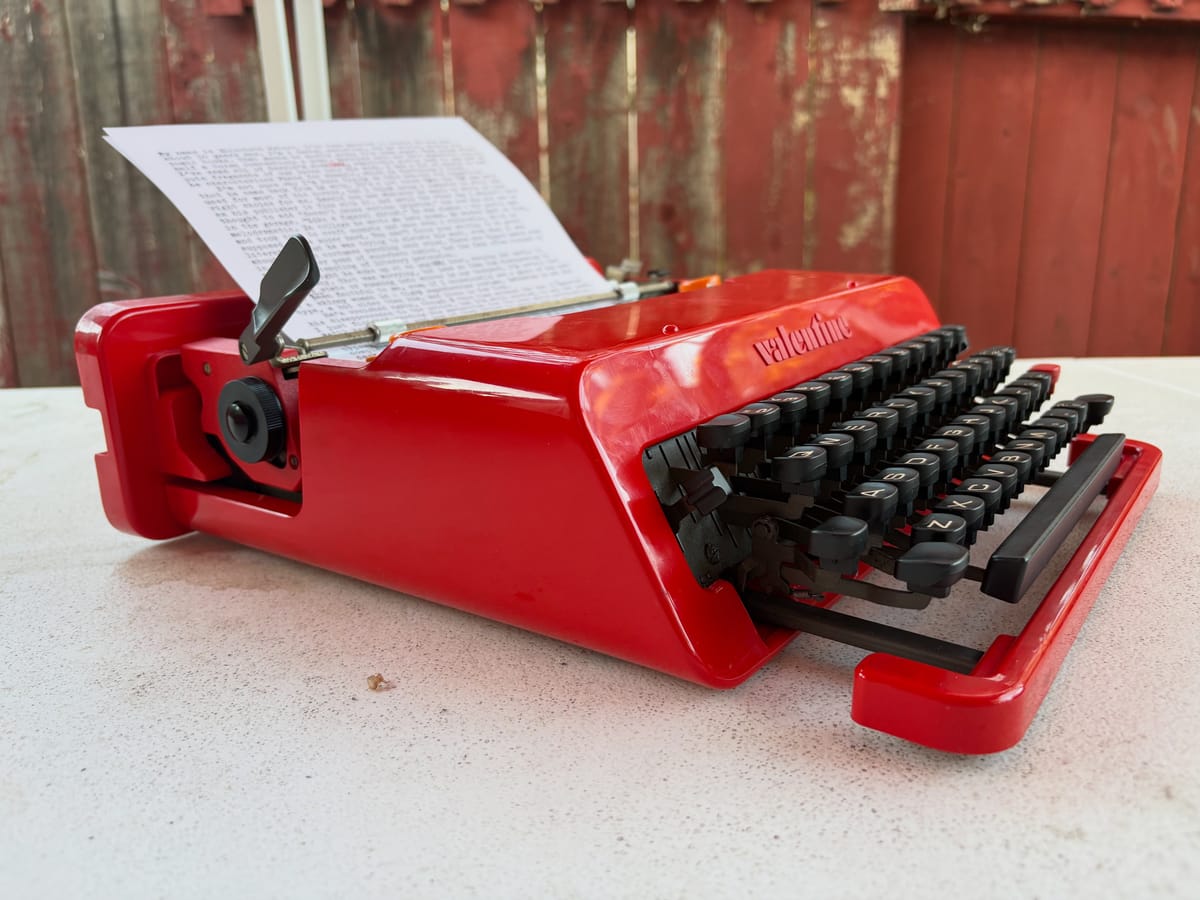
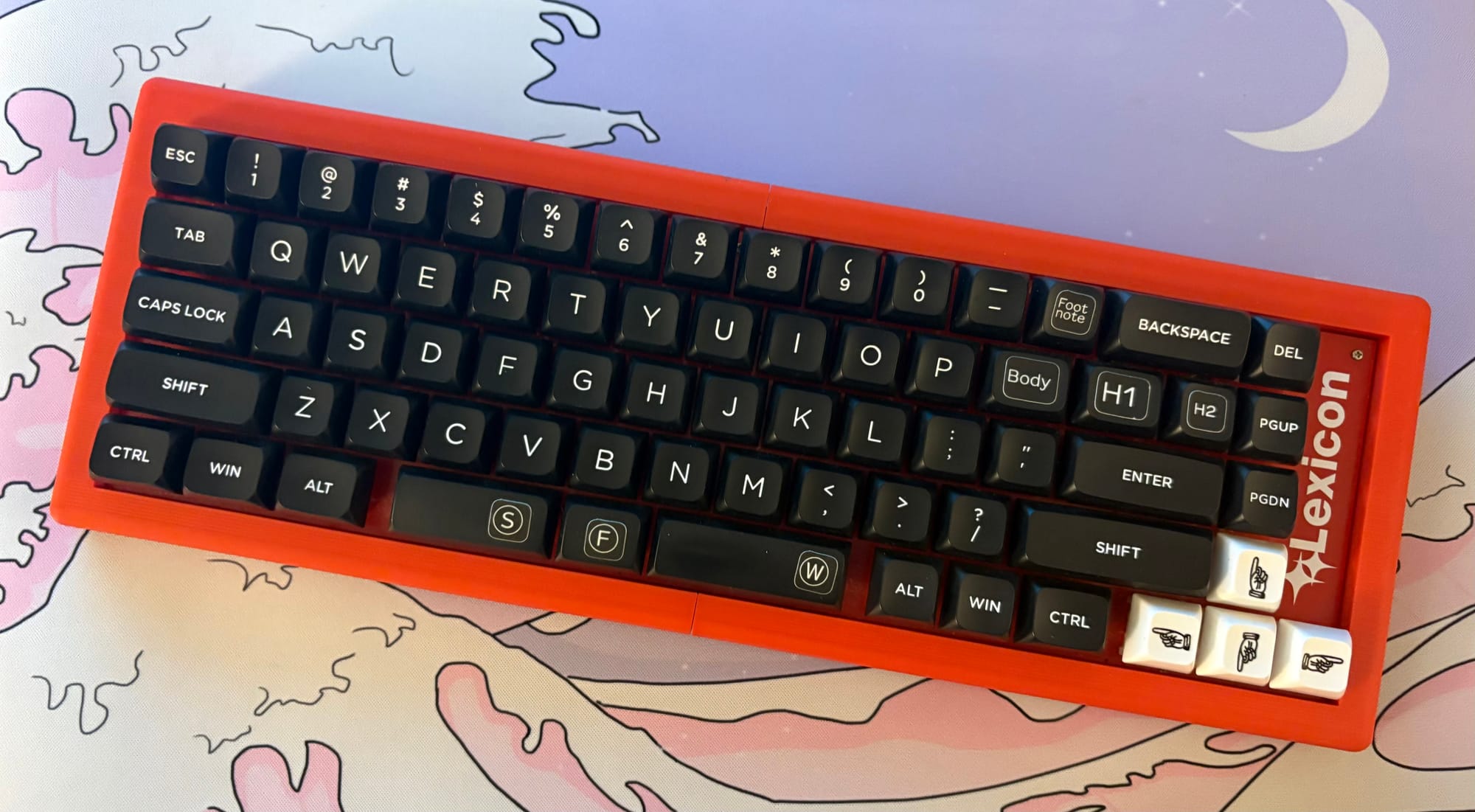
I’ve experimented with all sorts of tools for the actual writing and come to the conclusion that it ultimately comes down to personal preference. C.S. Lewis hated typewriters and preferred to write by hand (the fact that he smoked pipes constantly and thus wanted a hand free may have been related), but a host of 20th Century writers adored them. Computers have all kinds of advantages, like how it’s trivially easy to fix mistakes, and starting around the 1980s, writers embraced them in a big way. William Gibson famously wrote Neuromancer on a Hermes 2000 manual typewriter, but he switched to a computer before long. Today computers provide all kinds of distractions, to the point where some writers look for ways to get away from all the notifications and temptations of today’s PCs. There are focused writing apps and even dedicated devices that try to strip away everything except typing words into a document. I went as far as to learn steno (though I’m currently out of practice) and even designed my own writing-oriented mechanical keyboard, the Lexicon.
I have the aforementioned notebooks and fountain pens, an Olivetti Valentine manual typewriter, an Android e-reader that can run the Word app, and of course my laptop and desktop computers. If it came to it, I could probably rig up half a dozen more writing devices from stuff I have around the house. I jump around between them a lot, depending on my mood, the story I’m working on, and external factors like the weather. When I was writing from the perspective of a character using a typewriter, doing the first draft on an actual typewriter was great, but I’m not going to use it when my roommate is trying to sleep. Cafes, libraries, public parks, and so on can all be good places to get a change of scenery. David Lynch liked to go to Bob’s Big Boy every day and have coffee and a chocolate milkshake while he worked on ideas for his projects.
Fight!
Genre fiction is rife with entertainingly epic battles of all sorts. In video games, a fight can just be a minor encounter, a way the game’s mechanics can sap some of the player’s resources and provide rewards. A playthrough of Final Fantasy VII can easily have over a thousand discrete battles, and a novelization that included every single one would be excruciating. Non-interactive entries in the franchise like Final Fantasy VII: Advent Children do have plenty of pitched battles, but they don’t waste time showing Cloud & co. killing random critters on the overworld map. Even isekai and LitRPG novels will quickly fall into summarizing these things rather than portraying each and every instance of the protagonist killing a slime.
Video games’ interpretations of Dungeons & Dragons have helped foster an image of combat as something frequent, even routine for characters. Even setting aside how unrealistic that is, fights can be boring. In movies, good choreography can add spectacle to a scene, but for a fight to be worth the audience’s time, it should be about something more than which guy can punch harder. In the original Star Wars trilogy, the lightsaber fights aren’t especially impressive as action scenes, but the sheer weight of Obi-Wan facing Darth Vader or Luke confronting his father makes those scenes riveting nonetheless. The lightsaber fights in the prequel trilogy are much more impressive technically, but Qui-Gon Jinn slicing through droids or even fighting Darth Maul—who is barely a character—isn’t nearly as compelling. In fiction, a good fight is about something, and it has consequences that drive the story. Professional wrestlers know this, and while pro-wrestling matches vary wildly in quality, the good ones tell a story that is part of the promotion’s ongoing testosterone-fueled soap opera.
In real life there are so many factors that, particularly on an individual level, outcomes can be flukes. A single stray bullet, one little ricochet, and mean the difference between a happy homecoming and going home in a box. While that kind of brutal, random tragedy is absolutely a valid occurrence in fiction, more often than not, in fictional fights things happen with a clear cause and effect. Anime will often pit a hero against a superior foe, and then tell the story of how the hero rises to the occasion. JoJo sees through the enemy Stand-user’s deception, Goku’s grief at last ignites the power of a Super Saiyan to defeat Frieza, and rather than fighting Walpurgis Night head on, Madoka at last makes a wish that changes the entire game.
While having characters fight a lot is valid, so is not having any combat at all. For most people, combat is rare if not unknown, and leaving battles out of the equation still leaves all kinds of room for intense, pitched conflict if that’s your goal.
Ad Hoc Planning
For a little while I experimented with having ChatGPT analyze my writing and provide suggestions for how to work out a given plot beat I was having trouble with. There are innumerable external issues with using an LLM—I have a whole essay/rant about it—but for my process I just found that its suggestions were usually mediocre and its answers still have hallucinations, even with regard to things within the same conversation. I finally decided it was better for me as a creative human being to do the actual work. There have been studies suggesting that frequent LLM use correlates with a decline in cognitive skills, not unlike how society coddles rich people so much that their frictionless existence also takes away challenges that keep a mind sharp.
[Update: Serdar over at Infinimata Press has some further thoughts on "friction" and its effects on the human mind.]
Sometimes I resort to asking friends or social media followers for ideas, but for me the most reliable path to figuring out a given story beat is to sit down with a notebook and start writing about it until I have it figured out. The process of solving the question of how to get where the story needs to go—and sometimes figuring out where it needs to go in the first place—is one of the great joys of writing fiction. Lately since I’ve made a point to take this approach whenever I’m stuck, I seem to be getting better at it, to the point where I sometimes feel a little disappointed that after taking the time to set up my typewriter, I get where I need to go after a few sentences.
Writing advice will typically say something to the effect that a story needs a conflict, with a literal or metaphorical antagonist. Like every rule there are exceptions to that, but I find that for me looking at it in terms of “the conflict” is a little too abstract. I’ve found that asking, “What do the characters need to learn to resolve this?” is much more effective for answering those kinds of narrative questions. I came up with that approach while watching Amphibia (the Disney cartoon series created by Matt Braly), which is very much about the characters learning and growing.
Dreaming
My inner monologue never really shuts up, and these days I almost always go to bed thinking about my writing projects. Sometimes I imagine I’m being interviewed about my book, sometimes I play out possible scenes in my head, and occasionally I imagine a crossover with some other work. The proportions of each seem to vary depending on the work. For the Xeroverse it tends to be more interviews, while for Memes of the Prophets it’s more crossovers with other isekai and LitRPG titles I enjoy.
If a writing project goes on for any length of time, I’ll start making a playlist for it, slowly accreting a bunch of songs that resonate with it and inspire specific scenes. I subscribe to a streaming service (Apple Music, but the specific one isn’t important), which gives me an absurdly large library of music to sift through. While I often listen to podcasts and audiobooks while driving, I spend even more time listening to my current projects’ playlists on shuffle and picturing different possible scenes from the story.
Aside from entertaining myself, it helps to play around with different concepts that could potentially go into the book. Imagining the party from Memes of the Prophets ending up in the world of KonoSuba led to a comedy beat where Darkness sees Galatea and realizes she would very much like a large, beautiful woman to step on her, which makes things weird given how gentle Galatea is with anyone she cares about. An actual crossover with a highly successful Kodansha title is unlikely, but I can take the overall idea and plug it into my novels, hence when Galatea does find a girlfriend in the story, it’s going to be a masochistic noblewoman, and comedy ensues.
Revisions
Eventually all this stuff will lead to a finished first draft, but even the most promising first draft inevitably needs work. I don’t have a formal process for this, so it essentially amounts to repeatedly re-reading various parts of the story and messing around. With my writing habits that includes a lot of simplifying sentences and adding little details, whether to shore up errors or just to add stuff I think is cool.
The Word app has a “Read Aloud” feature, which has become part of my process in that I’ll sometimes use it to listen to my manuscript. The results aren’t up to snuff for an audiobook, but hearing a humanlike voice reading my prose makes certain issues stand out more, especially the kinds of mistakes that spell checkers don’t catch. I can even listen to it while driving, though the temptation to fix mistakes while on the road is a bit of a problem admittedly.
The later seasons of Game of Thrones had all kinds of problems, but the biggest source of those issues was that the showrunners had a particular ending planned and forced it through despite the show having evolved in a different direction. As a novel writer I don’t have to think about actors’ performances shaping the characters, but even pure, solitary writing can evolve in unexpected directions. I’ve learned the hard way, through both running TTRPGs and writing fiction, that you can’t let yourself get too attached to specific scenes. No matter how cool a given scene may look in my head, it may turn out to not fit into the overall story or simply be a bad idea in the first place. You have to be willing to look at your own work with a critical eye. Those Cul de sacs can still be learning experiences though, and I try to set them aside in case I find a use for them somewhere else.
Beta Readers
Getting feedback is weird because there’s a natural tendency for the brain to interpret it as an attack, something that makes you feel shitty. You pour your heart and soul onto the page, and your good friend says this or that part of it kinda sucks or doesn’t make sense, which just feels bad. It takes some practice and humility to take feedback, even negative feedback, as the potential gold that it really is. Not every bit of feedback is going to be the right thing for you to follow, but when you get good-faith feedback, you absolutely need to seriously consider it. I’m a lot better about that than I used to be, though having people you can trust to give you constructive feedback rather than just bashing your work is important too.
Editor
As a rule, if I’m expecting someone to pay money for a book, I’ll hire an editor to go over it. Since I self-publish, that amounts to paying someone to do an editing pass on the manuscript. That helps improve the book on a micro level, since unlike beta readers, the editor is checking every little sentence. My current go-to editor is Diana Gunn (who is also a murder mystery writer in her own right), and she’s not only edited two of my books so far, but helped me overcome some habits. One little rule I learned from her is to not start sentences with “It was,” because it’s virtually always possible to do something more evocative.
Most of the editors I’ve worked with use the Track Changes feature in Word (or another word processor) to annotate the manuscript with corrections and comments, which I can then go over and accept or reject (but mostly accept), until I have something like a final draft. I still go over it at least one more time after that, especially since mistakes can creep in while I work through the suggested changes in Word.
Layout and Publishing
The final step of the process is turning the edited, finalized manuscript into a book, usually both an e-book and print on demand paperback. By that point, I’ll have gone over the book so many times that I can barely stand to look at it, which makes me glad that I’ve gotten enough practice to avoid too much in the way of back and forth in the self-publishing process.
E-books have gotten a lot easier to deal with, and a lot of e-book publishing sites will let you just upload a .docx file that they’ll then convert (though some require you to include a table of contents and/or ISBN). For a while Amazon preferred the .mobi format for e-books, but now .epub files are the standard for basically all e-readers and reader apps. E-books do somewhat limit the use of special formatting and characters however, and more or less require a reflowable single-column layout. If you do need to convert to e-book formats yourself, there’s a free multiplatform app called Calibre that does an excellent job. If you distribute through sites like DriveThruFiction, you can offer a PDF file as well, which lets you give readers the precise print format in digital form, including your own specific choices of fonts and whatnot. These may be awkward for e-readers, but can work well on other devices, as long as the screen size is comparable to the PDF’s page size.
The basics of book layout are a little tricky but not too complicated:
- For a novel you generally want a maximally readable serif font. Times New Roman is so common that it’s become a bit passe, but there are tons of others like Garamond, Caslon, Goudy Old Style, etc. This is not the place to be gimmicky. I like to mess around with fonts a little bit in my novels, but I try to still use the most readable fonts possible for it, like putting characters’ text messages in Helvetica.
- Headers and so on can potentially be a bit more expressive, but at the end of the day readability is still king. You can find high-quality, royalty-free fonts at Font Squirrel.
- Other graphical flourishes are best done as vector graphics for print and pixel graphics for e-books, which means a little tedium for doing both print and e-book versions. You can find a massive collection of icons for various things at The Noun Project, and there are all kinds of symbols available just in Unicode.
- Novels will typically have headers with page numbers (on the outside edge), the author’s name (on one side), and the book’s title (on the other side).
- The inner margins should be a little wider because they sit close to the spine, where the paper can obscure text printed there. Also, margins tend to be a little wider than you might expect. You don’t have to worry too much about being maximally space-efficient; the goal is to make it easy for the reader to point their eyes at the page for extended periods.
That’s a basic summary, and you can find more info online or by looking at existing books, preferably with a ruler on hand. I probably should learn a proper layout program—something like Adobe InDesign, but preferably one of the cheaper alternatives—but I’ve gotten pretty good at doing these layouts in Microsoft Word.
Covers get a lot more into the realm of graphic design. There are tons of people who specialize in doing book covers for hire on sites like VGen, though I typically commission artwork and then put the cover design together myself. Regardless, remember that printing, especially Print On Demand printing, isn’t perfectly precise as to the position of the content on the page or cover, so there needs to be a little extra space between the edge of the page/cover and anything that needs to be clearly readable.
Then What?
Marketing one’s books is something I’m still trying to learn how to do, and you may have guessed by now that this blog is partly a way to do that.