An American Monomyth

To accompany the Xeroverse Tetralogy, I'm also working on a nonfiction book tentatively titled The Trouble with Superheroes, which lays out the various issues I see with the genre and how it could be better. One of the linchpins of my critique is to take a close look at the uniquely American notion of heroism that they inherited from pulps and cowboy movies. It's a highly pervasive aspect of American culture, one that afflicts not only fiction but how people want society to operate.
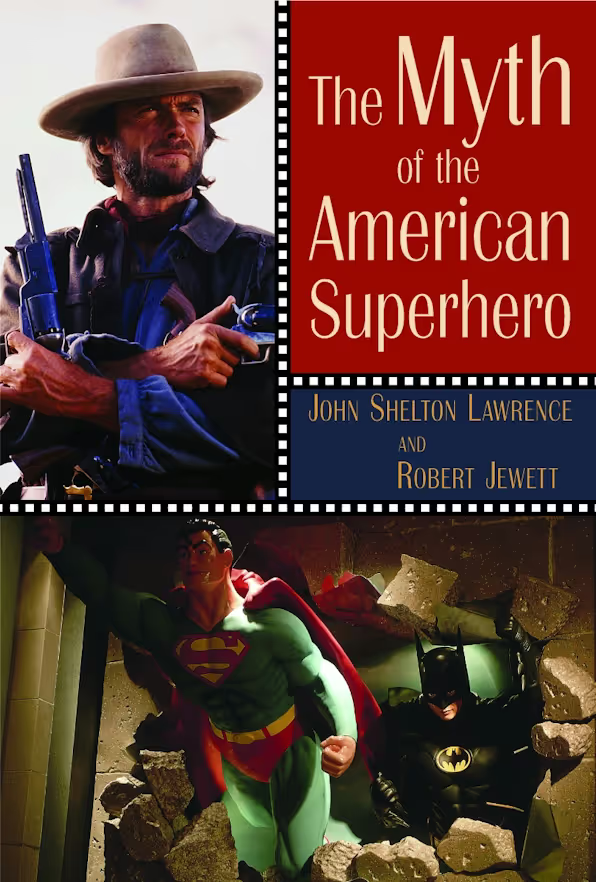
In The Myth of the American Superhero, John Shelton Lawrence and Robert Jewett formulate what they call the “American monomyth.” Though they draw inspiration from Joseph Campbell’s flawed monomyth, I think their narrower formulation results in something that’s instructive for a powerful (though not universal) stream of American thought. The simplest formulation of the American monomyth they provide is as follows:
A community in a harmonious paradise is threatened by evil; normal institutions fail to contend with this threat; a selfless superhero emerges to renounce temptations and carry out the redemptive task; aided by fate, his decisive victory restores the community to its paradisiacal condition; the superhero then recedes into obscurity.
In a mere 50 words we have a pattern that’s familiar, distinct, and in some places, worrisome. While there is a definite danger in putting too much trust in institutions, hyper-focus on the individual can serve to sabotage cooperative efforts. In the American monomyth, small towns are paradisical places full of hard-working, honest people. In reality, how good or bad people are doesn’t have much to do with the sizes of the settlements they live in, and small towns simply have different problems. In the mythos, despite their virtues, these idealized small-town folk are incapable of protecting themselves from outside threats.
Other cultures have different conceptions of what constitutes heroism, and in fact this American formulation is an outlier for excluding spiritual development and addressing systemic problems from the list of heroic virtues. East Asian heroism often involves fighting against corruption, even if it doesn’t normally extend to upending the entire system. China’s concept of the “Mandate of Heaven” means that if things go badly for the nation, the leader has lost heaven’s support and deposing them is entirely legitimate. Japanese heroes emphasize cooperation and hard work, and East Asian heroes in general tend to acquire their powers through practice rather that heritage or circumstance. Rather than being a demigod to begin with or getting a radioactive spider bite, the East Asian hero will do things like learn to fly by meditating under a waterfall for a decade. Even when they have a major advantage to begin with (like with the Saiyans in Dragon Ball), the great heroes still have to put in the work and push themselves to greater heights to save the day.
Like these other hero archetypes, the hero of the American monomyth comes from America’s particular circumstances. Protestantism, rugged individualism, our peculiar and bloody racial history, and everything that went into our westward expansion demanded a new notion of heroism. As such, it bears the taint of the ethos that let white protestant settlers commit genocide in the name of “civilization.” At its extremes it justifies utter brutality by way of a black and white morality that is happy to arbitrarily assign the villain role to anyone inconvenient for the white man’s domination of the land.
Early on, one of the most important vectors for this notion was the wild west shows of Buffalo Bill, which portrayed heroic American men conquering the frontier. These shows were a massive success despite playing fast and loose with the facts. The view of American heroes as a virtuous force for civilization played into Manifest Destiny, and it went all the way to the top. Theodore Roosevelt was downright vicious to peoples he could write off as “savages,” and he was extremely willing to overlook bloodied hands if those hands were sufficiently pale and “civilized.” That attitude helped launch the Spanish-American War, where Roosevelt distinguished himself in combat, leading to his exploits becoming new material for Buffalo Bill.
In the world of film, the most celebrated enactor of the American monomyth is John Wayne. He played a variety of roles—including playing Genghis Khan in yellowface for 1956’s The Conqueror—but audiences overwhelmingly associate him with westerns. In movies like The Man Who Shot Liberty Valance (1962) and The Shootist (1976) he portrayed gunfighters who disdain femininity and intellectualism in favor of righteous violence. His work conveys a message that government and law are powerless—especially on the frontier—and some men just need killing. When Ursula K. LeGuin complains about “heroes” who deliver violence and hog the spotlight, most any John Wayne character fits the bill.
The real-life John Wayne (his real name was Marion Robert Morrison) was a piece of shit. At the 45th Academy Awards in 1973, Marlon Brando declined the Best Actor award for The Godfather and had the Native American actress and activist Sacheen Littlefeather address the crowd to call out the racist portrayals of native people in Hollywood. The crowd’s reaction was mixed, but John Wayne in particular had to be restrained from trying to drag her off the stage. He was a racist and alcoholic, he abused and cheated on his wives, and when making movies he was terrible to everyone around him. That hasn’t stopped people from lionizing him of course, with many honors bestowed on him including a posthumous Presidential Medal of Freedom. He’s not the only entertainer to receive that honor, but it’s nonetheless strange for the guy from the cowboy movies to be in the company of Mother Teresa and Rosa Parks.
Justice or Vengeance
John Wayne exemplifies an American tendency to conflate justice and vengeance, but others would take it even further. In the 1970s and 80s, there were people who felt inner city crime was out of control, and their reaction was to long for brutal vigilante justice. This sentiment is what made Death Wish (1974) such a hit, and it’s the same attitude that fueled Marvel’s Punisher and his ilk. Both Paul Kersey (Charles Bronson’s character in Death Wish) and the Punisher lost happy families to criminals and became vigilantes who seek out and slaughter the criminal element. Brian Garfield, the author of the original Death Wish novel, intended it as a cautionary tale against vigilantism, but his protestations fell on deaf ears as studios made four sequels and a whole genre of revenge flicks.[1] Scorsese’s Taxi Driver (1976) was a deliberate attempt to portray the horrors of this kind of vigilantism, but audiences didn’t always take the intended meaning from it.
Their use of righteous violence is an evolution of the American monomyth, but with some of the hero’s virtues stripped away in favor of raw fury. The Punisher doesn’t have to resist temptation because he’s wholly focused on his mission. In important ways these vigilantes break the tenets of superheroics, making them antiheroes. They’re capable of being proactive, of working to change the world. In superhero stories that’s normally the purview of villains, though both villains and antiheroes are often misguided. These narratives don’t really have room for characters who seek to change the world in an unambiguously good way.
Although the public’s appetite for vengeance is down compared to when Death Wish was released, those bloodthirsty attitudes never went away. These days that’s depressingly easy to see on social media, especially on X/Twitter. Some people will simply write off other people as less than human, and at turns bay for blood when those “lesser” than themselves step out of “their place,” or laud (and donate to) perpetrators of the kind of violence they seemingly wish they could dispense themselves. Some people own guns because they enjoy going to the range or out of a solemn obligation to defend their loved ones, but others are itching for the chance to end a human life with righteous bloodshed. Entirely too many real-life cops are Punisher fanboys, and the fact that in the comics (and more recently in Daredevil: Born Again) Frank Castle is at least as opposed to corrupt, lawbreaking cops as dangerous criminals hasn’t deterred them from making Punisher skulls a worryingly common symbol.
Revenge fantasies have become less mainstream, and less a part of pop culture, particularly the kind that goes into big blockbusters. Movies about a character taking bloody revenge like Kill Bill (2003/2004) and Mandy (2018) still come out, but they’re not about killing common street thugs. In Kill Bill the Bride is going after elite assassins, while Mandy has Nic Cage’s character taking down the cult that took and killed his wife. That’s a far cry from seeing Pierce Brosnan executing common muggers in the street.
I think the fundamental problem with the morality of the American monomyth is that it glosses over how in real life, masculine brutality rarely comes with overall moral virtue. The men held up as paragons of those values at best still retain some of the bigotry of their times (like Theodore Roosevelt) but are too often violent abusers who’ve latched onto an acceptable avenue for acting on their monstrous urges (like Joe Arpaio). Even if a vigilante has pure motivations and strives to act ethically, the research shows that vigilantism ultimately serves to increase violent crime. Empirical research often reveals counterintuitive realities that point to drastically changing how we approach things, but people love their simple narratives and mythic solutions.[2]
The creators of this kind of media will of course ignore these glaring issues. If anyone in these narratives asks whether the monomythic hero might be sinking to the bad guys’ level, it’s usually a woman, and she will inevitably be proven wrong. The protagonist of Death Wish not only gets away with killing a bunch of muggers but heralds a drop in violent crime reported all over the media. In real life, the idyllic Tucson, AZ, where the character has his epiphany about using redemptive violence, objectively has a much worse per-capita crime rate than NYC.
A more direct and disturbing example of the American monomyth affecting the real world comes from 24 (2001), the Fox series starring Kiefer Sutherland. Its protagonist Jack Bauer is a tough as nails anti-terrorism agent, and he regularly resorts to torture to get the information he needs to save the day. Not only was a depiction of torture as a heroic act out in the world, but Supreme Court Justice Antonin Scalia cited the show regarding the legitimacy of torture in the War on Terror. In real life torture is ineffective and even counterproductive, as it tends to produce false information due to victims saying whatever they think will get the torture to stop. Building a rapport with prisoners is far more effective, but it doesn’t make anyone feel like they’re John Wayne.
As if that weren’t enough, Timothy McVeigh and Ted Kaczynski were both fans of stories that came from the American monomyth. In their eyes, their deadly bombings were in part a real-life enactment of that kind of heroic violence. McVeigh cited the Rambo trilogy and Unforgiven among his favorite movies. He was also a fan of The Turner Diaries, a novel that presents a virulently racist fantasy of violently purging America of non-white people and everyone else the author found undesirable. To any decent human being the novel is utterly vile, but from its own twisted, bigoted perspective, it’s another American monomyth of redemption through violence. McVeigh vehemently opposed even the mildest restrictions on the right to bear arms and firmly believed that the Oklahoma City bombing was part of a righteous battle against the federal government. When a potential accomplice questioned whether it was right to blow up random secretaries and such, he cited the destruction of the Death Star in Star Wars. He was able to simplify the entire federal government down to an Evil Empire.[3] There are countless legitimate criticisms to make of the U.S. government, enough that getting rid of it should be on the table, but that doesn’t mean the people at the VA counseling center (one of the many offices in the Alfred P. Murrah Federal Building) deserved to die. Even the Unabomber thought McVeigh’s methods were flawed.
Fixing Things
The Myth of the American Superhero came out in late 2001, shortly after 9/11, and in the rescue efforts the authors saw a repudiation of the thesis of the American monomyth. As terrible as that day was, New York’s first responders went in and worked tirelessly to save lives. They were well-organized and competent, and no one had to disobey orders to get the job done. Later on, we’d learn that the government wasn’t bothering to get those first responders the healthcare they needed, which led to Jon Stewart personally helping them fight to get it.
As soon as things fell out of the mythic arena, a lot of people stopped caring, and the downright worshipful attitudes towards those real-life heroes showed themselves to be hollow. Firefighters and paramedics who objectively saved many human beings from death at great risk got the shaft, while people turned Oliver North—who broke the law to enable atrocities—into a celebrity. The 9/11 hijackers meanwhile were a small group who saw themselves as heroes who would strike a blow against America’s evil empire. If you look at the issues that Osama bin Laden cited as the reasons behind the attacks, they include things that American conservatives would agree with (like gay people existing), as well as more legitimate objections to America’s foreign policy in the Middle East. None of that justifies those murderous attacks of course, but America’s own misdeeds around the world have claimed even more lives, including those of its own citizens. In an important sense the American monomyth is also a myth about the character of America itself. A lot of Americans want to be part of John Wayne: The Country™ and have no interest in realities that get in the way.
The fact that the logic of the American monomyth applies more to the 9/11 hijackers than the 9/11 first responders is disturbing, and it points to the biggest issues with it. The American monomyth doesn’t allow for collective action or peaceful resolutions. Instead, it demands that a lone hero resolve things with violence. It helps explain both why many people idolize violent monsters and why they don’t see protest as legitimate. Pundits would rather have a “hero” president and denigrate protestors as weird losers wasting their time. We managed to turn Martin Luther King Jr. into a heroic figure, but during his lifetime a lot of people saw him as just another uppity [slur] causing trouble and preferred the likes of John Wayne.
Ultimately, we need to remember that, as Margaret Mead put it:
Never doubt that a small group of thoughtful, committed citizens can change the world; indeed, it's the only thing that ever has.
[1] Garfield wrote a sequel, Death Sentence (1975), which showed vigilantism ultimately contributing to a cycle of violence. It received a loose film adaptation in 2007, which received poor reviews.
[2] One less destructive example of this tendency is how the research shows that open-plan offices hamper workers’ productivity, while remote work doesn’t. The reason appears to be remarkably simple: the former creates distractions, while the latter removes them. Despite these objective realities, a massive contingent of managers opposes remote work and insists on open-plan offices.
[3] Tim Pool once tried to compare Sam Seder’s utilitarian approach to voting to Thanos, as though voting for Hillary Clinton to avoid a Trump presidency was comparable to killing half the universe. Seder’s reply was eminently sensible: “I don’t care.”