Enter the Arena

“If he could but have ended the war single-handed, it might have been different. But he was not great enough for that. He had been a thousand men, perhaps ten thousand, but he could not be millions. He could not wrap his arms around a continent and squeeze it into submission. There were too many people and they were too stupid to do more than fear him and hate him. Sitting there, he realized that his naïve faith in himself and the universe had foundered.”
—Philip Wylie, Gladiator
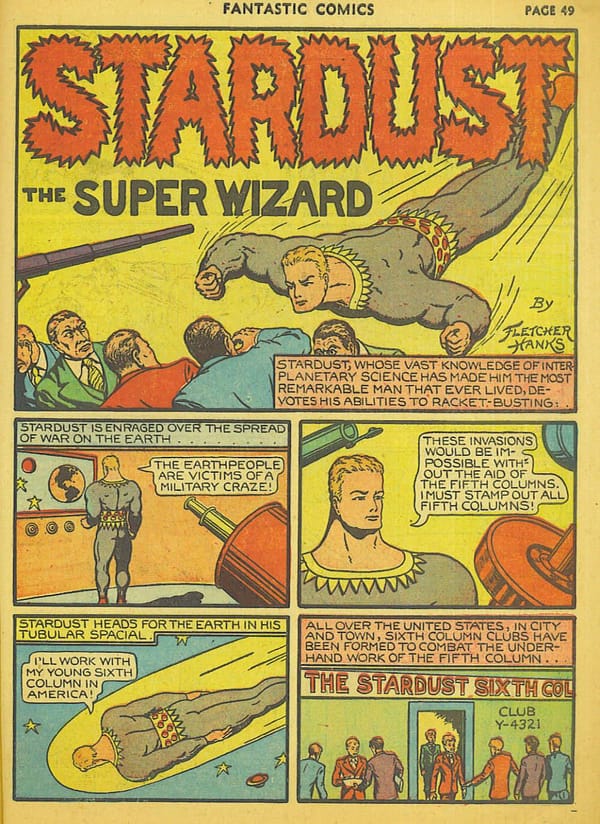
Debuting in 1938, Superman is essentially the first superhero character. Today we know him as the flying Kryptonian refugee who tangles with the likes of Lex Luthor and Darkseid, but he began as a non-flying guy from an unspecified planet, who used his powers (and the information he could get as a reporter) to deal with domestic abusers, corrupt politicians, and greedy landlords. The character wasn’t completely without precedent, and while it’s not clear if it directly influenced Siegel and Shuster, the 1930 novel Gladiator by Philip Wylie is notable as a “proto-superhero” story, one of the transitional forms on the way to Superman and the genre as we know it today. Its protagonist is superhuman, which at the time was much more common in mythology than any sort of contemporary fiction.
If you’re interested in reading Gladiator, it’s now public domain and available for free from Project Gutenberg, though this essay has a lot of spoilers. My non-spoiler review is that it’s an interesting and well-written book, but it really shows its 1930 attitudes in places.[1]
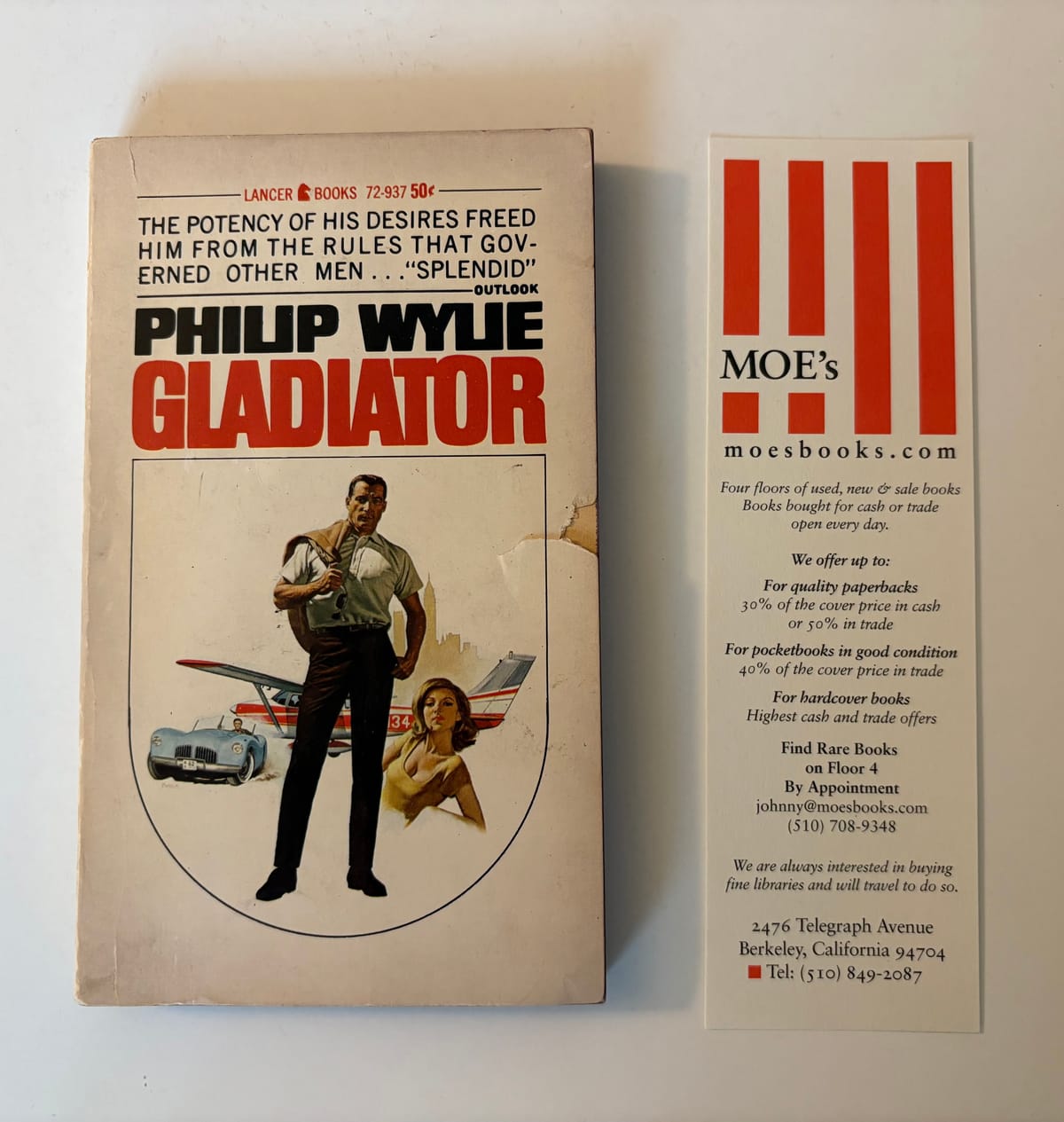
The book has appeared in multiple editions through various publishers, so it’s had multiple cover designs. The edition I found at Moe’s Books in Berkeley is from Lancer Books, which would put its printing in the late 50s or early 60s. The cover has artwork of a swaggering, masculine man, a beautiful woman, a sports car, and a plane, and combined with the text on the cover, I was expecting a superhuman James Bond. That is not what I got. Instead, Gladiator is a cynical and melancholy tale of irresponsible science and a superman who never finds a place to belong or a purpose in life.
It begins by telling us about the father of the superman, Abednego Danner. “Abednego” is the name of one of three men who were divinely spared from being burned alive for refusing to bow to the image of King Nebuchadnezzar II in the Book of Daniel. I’m really not sure what Wylie is trying to say with this choice of names, but it’s a niche Bible reference. Abendego is a scientist who hates his wife, a nagging fundamentalist Christian who hates how he has a lab inside the house. Being aromantic myself, getting married was never something I seriously considered, even before I learned that “aromantic” is a thing a person can be. When I was doing online therapy, my therapist was a lesbian from Wisconsin, and she’d initially married a man and had two kids simply because that’s what you were supposed to do. No marriage is perfect, but making it an obligation seems like a surefire recipe for a lot of unhappy homes. If I imagine myself living in such an era and culture, it’s easy to picture a loveless, obligatory marriage that doesn’t accomplish much more than creating an appearance of normalcy. The Danners seem to barely tolerate one another, but divorce is never on the table.
As the story unfolds, Abednego is using his lab to work on a formula that he hopes will give humans the proportional strength and durability of an insect, and he begins experimenting on animals. I won’t get into the details here because I don’t want to subject readers to descriptions of animal cruelty, but he has a horrible success with a cat who he names Samson. When his wife becomes pregnant, he gives her drugged wine—never mind that people have understood that alcohol is bad for a fetus since antiquity—and injects the unborn child with his serum. This is despite his utter horror at the idea of possibly creating a superhuman girl.[2] It’s hard to divine Wylie’s motives, but Abednego is a deeply unethical scientist, a poor husband, and a questionable father. As the book portrays him, he doesn’t have much going for him besides his intellect and work ethic.
The boy, Hugo Danner, is the protagonist of the story. It follows his life, which is full of disappointments. Where his father comes off as misogynistic, Hugo seems to genuinely want to find female companionship, to form a long-term relationship with a good woman, but it never lasts. I haven’t explored Wylie enough to know his own attitudes towards women, but his first nonfiction book, Generation of Vipers (1946), includes a diatribe about “momism,” the “cult of motherhood.” None of the depictions of women in Gladiator are awesome, but that seems to be more a result of 1930-ism than any exceptional misogyny on the author’s part.
Anyway, as a child Hugo is a bookworm, and his parents impress on him that he must be extremely careful of his unnatural strength. This turns out to be good advice, because very few people witness his power without it inspiring hate and fear. Wylie seems to be telling us that superior men are hated and feared by their inferiors, but in real life, exceptional people are also variously overrated, given unhealthy levels of worship, or simply earn opprobrium with their actions and attitudes. In college Hugo is able to control himself well enough to become a star football player—a great example of how being exceptional can lead to unmitigated popularity—but then he kills another player during a game. Everyone writes it off as a tragic accident, but he’s so wracked with guilt that he leaves school. His other ventures—becoming a circus strongman, working in a steel mill, taking a job at a bank, etc.—don’t result in deaths, but each time people learn of his unnatural strength, it blows up the life he’d made for himself, even when he's using it to save lives.
When World War I breaks out, he joins the French Foreign Legion and eventually transfers to the U.S. military. In the war, his comrades variously decide that they don’t care as long as he keeps saving lives or buy his line about how that’s just how they make them in Colorado. While he does save a lot of lives—and kill a lot of men from the other side—he also watches a lot of his comrades die horribly. After running into an old college buddy who was blinded by mustard gas, he laments how despite having the power of a thousand or ten thousands of men, he can’t wrestle a whole continent into submission. The reality of the fighting destroys his enthusiasm for war, and he decides that the war is a madness that must end. Given that this is WW1, he's not wrong. He hatches a plan to requisition a plane, fly it as far as it'll go, and then head into the German high command to smash their leaders and anyone else who gets in his way. He’s nearly ready to depart when news arrives of the armistice. Everyone—everyone who survived—gets to go home.
After the war, he finds that a banker he’d met had invested his money to profit from the war, so he has a cool million dollars. That would’ve been in 1918, so adjusted for inflation he’d have about $21 million today. Not enough to do absolutely anything, but enough to live comfortably for the rest of his life and then some. Rather than living an easy life, he sends the money to his parents and tries to work for a living in New York. Despite the war having been one big meat grinder feeding on the men involved, there are enough returning soldiers that it’s incredibly hard to find work. He ultimately ends up returning to Colorado to see his father before the old man passes, and his father gives him the notebooks with the formulas that created Hugo.
Hugo winds up joining an expedition to explore Mayan ruins. When the head of the expedition finds out about Hugo’s powers and Abednego’s notebooks, he gives him a vision of creating a new race of supermen who will change the world forever. Hugo likes the idea at first, but as he thinks it through, he grows horrified. Finally, he goes out at night and begs God to give him guidance. The only response is a lightning bolt that leaves a blackened corpse and reduces his father’s notebooks to ash.
Despite predating the genre, in some ways the story reads like a deconstruction of superheroes. It presents superhumans as sitting on a razor’s edge, teetering towards pointlessness or apocalypse. Where Superman finds both a stable mundane life as a reporter and a higher purpose as a costumed superhero, the futility of Hugo’s power drives him to despair. Along the way, the story touches on several themes and concepts that would later become aspects of Superman and other major superheroes. There’s no direct evidence of the novel influencing those comic creators, but the parallels are nonetheless interesting.
- Hugo’s abilities—superhuman strength, toughness, and speed—are essentially the same power set as early Superman.
- As a boy, Hugo finds some solace in running around in the wilderness. He uses his incredible strength to build a fort, presaging Superman’s Fortress of Solitude.
- The super-formula, invented by one man and kept secret, parallels the super-soldier serum that made Captain America. And like Cap, he volunteered to serve in a World War.
- He enters a fighting match to make some money, just like Spider-Man, though it wasn’t nearly as much of a formative experience. Having the proportional strength of an arthropod is another thing they have in common.
I think the overall thrust of Gladiator is an exploration of power and what it means to affect the world. A given individual will have their mental and physical faculties, the money and connections they can leverage, and so on, which are major factors in how they can affect the world around them. Elon Musk has the highest net worth in the world, several large companies, and connections with countless rich and influential people. While he can’t get everything he wants, he can influence the world in ways that a normal person could only hope to as part of a massive movement. Paths to success and influence through physical achievement are few and far between, essentially limited to the upper tiers of professional sports. Perhaps there’s a point where superhuman physical abilities can change the world by brute force, but Hugo either isn’t that strong or never gets around to trying.
In Gladiator, Wylie shows us how he thinks a morally good and physically superior man would interact with the world. Hugo’s parents tried to instill good values in him, and through his adventures he shows that he values life, freedom, and hard work. However, since he lacks wealth—and in fact disclaims his million dollars on ethical grounds—he can seldom accomplish much more than the average man. He can tear a bloody swath through Germans with his bare hands, but by the time he has an inkling of how he might use his strength to end the war, it’s already over.
Today, superheroes are normally defenders of the status quo. Supervillains can be creative and carry the ambition to change the world, possibly even for the better, but stories inevitably have them pursue wrongheaded goals or adopt pointlessly destructive methods. In Avengers: Age of Ultron, Ultron says, “You want to protect the world, but you don’t want it to change.” That’s a completely fair assessment of the Avengers and superheroes in general, but of course Ultron’s idea of a necessary “change” to the world is the extinction of humanity.
When superheroes seriously try to change the world, and particularly when they succeed, it’s normally the domain of deconstructions. Alan Moore’s Miracleman has the title character use his abilities to bring about a new age of enlightenment, giving mankind a cashless, post-scarcity society. Invincible occasionally shows Atom Eve or Invincible trying to change the world, but like Wylie, its creators are deeply cynical about the possibility of such attempts actually succeeding. In Superfolks, the protagonist’s depressed state comes in part from the realization that he can’t fix the world by punching two-bit crooks, that for the real problems humanity faces, his powers are all but useless. Warren Ellis’ Black Summer opens with a superhero assassinating George W. Bush over the Iraq War, and the story is about the disaster that brings down on him and his team.
While there are exceptional people in the world, the “great man” theory of history is at best an oversimplification. Material circumstances, technology, and large cultural movements all play major roles in the course that history takes, and a lot of the “great men” were just the ones who happened to take up a role that several others could’ve played. Fiction, myth, and for that matter many tellings of history all insist that singular heroes make all the difference, but we all inevitably fall short of that ideal. Most of us can’t single-handedly change the world on any significant scale, and those that do almost always reveal themselves to have serious shortcomings. Gladiator shows us how being a superman isn’t enough, but it doesn’t tell us what is enough. We need to re-learn that we’re a social species and can do amazing things by working together.
[1] Like how Black people only get very occasional mentions, always in servant roles.
[2] I have a notion to try writing an alternate version of Gladiator called “Gladiatrix,” about such a girl, but I have a lot of writing to do.